Skip to content


Kids, I Have Kit Kats

Today I was running errands in town when I realized that I had yet to buy Halloween candy for any trick-or-treaters who may catch us at home tomorrow night. In previous years, I procured Halloween candy weeks ahead of time, under the guise of being prepared when it was all just an excuse to have a readily-accessible basket of candy in my house. This was one of several eating habits that, ironically, contributed to my current inability to consume anything with a number other than “0 g” next to the “Sugars” line in the nutritional facts.

But I’m not bitter. In fact, I’m sweet. Sweet as a Kit Kat. Because I truly believe that children should be allowed to semi-annually gorge themselves on candy before they grow up to be adults with dysfunctional endocrine systems. So I stopped at CVS and headed to the chaotic remnants of the seasonal candy-and-crap aisle.

You may be surprised (or doubtful) to learn that I can regard Kit Kats, Reese’s peanut butter cups, Skittles, and in fact any sugar-laden treat with as much interest as a panda would ponder a pizza. Just being near the Halloween candy in CVS made my pancreas churn.

I picked Kit Kats because they were my favorite Halloween candy, back before the candy bit me back. But wait, did I miss something? What happened to the foil wrapper that was so much fun to unfold? And is it my imagination, or have the snack-sized Kit Kats shrunk into fun-sized Kit Kats?

kitkat

That’s small! I’m sure the fine folks at Hershey’s would attribute the shrinkage to concerns about children’s sugar consumption and portion sizes, but of course this change is purely economical. There’s a decrease in the net amount of candy per bag, plus now I’ll have to distribute 2, maybe even 3 of these puny Kit Kats to each trick-or-treater to avoid looking like a sugar miser. And they’ll have to eat 3 of these Kit Kats to be sufficiently sophonsified. Maybe I should throw some glucose test strips into their bags while I’m at it.

Posted in Existence.

Tagged with .


The Never-Enders

There are some people with whom it’s simply impossible to end a conversation. Perhaps they lack some hormone or cluster of brain cells that alerts a normal person when the dialogue has become stale, awkward, or has just run its course. Normally at that point, one person will initiate a conversation closer by saying something generic and cheery (for instance: “Well, good luck with that!”), and the other person will gratefully lob back a sentiment equally as bland and blithe (“Thanks, I’ll need it!), and they will part ways.

But some people just don’t pick up on not-so-subtle hints that the chat is dead and needs to be buried. They just keep going. Here’s a totally made-up example:

“Well, good luck with that Ebay auction!” the conversation ender will say, inching away from the conversation never-ender.

“Oh, I don’t need luck. I just need to make sure that I’m at my computer at 11:37 tomorrow night.”

“Yes, well, good luck!”

“But, did you know there’s software that allows people to make an Ebay bid one second before the auction ends?”

“No, I didn’t know that.”

“I mean, I could use that software, but I wonder what would happen if two people used the software for the same auction! Have you ever considered what would happen if two people place a bid at the exact, and I mean the exact, same moment?”

“I don’t know.”

“I guess I would use that software for something that I really, really wanted. It depends on the fees though, don’t you think?”

The never-ender will persist, purposely or non-purposely ignoring any sort of verbal or bodily hints that the conversation has essentially become a one-sided exercise in narcissistic prattle. The ender will be struggling to remain polite while mentally plotting when and how to attempt another conversation closer, this time with more force and, if necessary, rudeness.

Today I saw two co-workers who I consider flagrant never-enders talking together. It sort of blew my mind for a second, like seeing the two funniest people I know together, or the two biggest dicks, or the two most avid foodies, or something of that order. I walked past them on my way to a meeting, my shoulders narrow and eyes down. And wouldn’t you know, when that meeting let out 20 minutes later, I past them again and they were still in conversation! That’s when I realized that these two people could very possibly sustain a never-ending conversation. I almost wanted to stick around, to see how and if it would end.

Posted in The 9 to 5.

Tagged with .


Gotta Jetta!

Please excuse the gushy nature of this post, as I generally loathe gushing. Especially when it comes to objects. Especially when those objects come with a hefty price tag. And especially when they carry an eco-friendly badge that, when scrutinized, reveals a bit of a green-washed smirk.

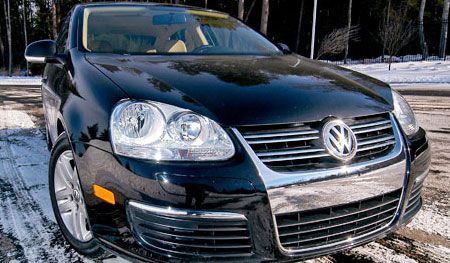
But… it’s here. Our 2010 Volkswagen Jetta TDI (black exterior with black leather interior, touchscreen radio, seat warmers, alloy wheels, turbocharged clean diesel engine that qualifies for a $1300 alternative fuel tax credit) has come home. And it is the most wonderful, amazing, stupefying car ever.

What would Jesus drive? If the answer isn’t a 2010 Jetta TDI, I don’t know what is.

Did I mention that it’s manual transmission? How daring am I, buying a car that I can’t even drive? In preparation for the Jetta’s homecoming, Mr. P has been giving me stick-shift driving lessons on his Honda Civic. Miles of confusion, frustration, and some yelling (reminiscent of when he taught me how to ski, only no crashes) and finally I can drive around the neighborhood without stalling and dissolving into whimpers. Still, I have yet to actually drive the Jetta because its gearshift is different from the Civic’s (6 gears instead of 5), so Mr. P will have to give me more lessons on the Jetta. Which, honestly, he doesn’t seem eager to do. I think he has designs on my car.

It’s ironic that the Jetta’s homecoming falls on the same day that I lost one hour of my life during a disastrous morning commute when I spent literally 40 minutes in a tunnel on a disabled train. (I know I’m prone to exaggerating train delays, but this time, I’m being truthful). After the train was pushed into Porter Square station by another train, I squeezed onto the packed platform, and watched three jammed-full trains roll past. It was a nightmare. I used yogic breathing to refrain from punching someone.

So yes, I’m aware that my excitement over my shiny new car isn’t the most eco-conscious or civic-minded sentiment. But after a decade of being at the mercy of the MBTA, the thought of commuting with this beauty, with its reassuring purr and heated seats, feels like salvation.

And there it sits, gleaming in the driveway, promising freedom, independence, and an escape from the whims of public transit.

jettatdi

Posted in Existence.

Tagged with , , .


Harvard’s Breakfast is Getting Cold

Harvard University became a minor laughingstock last spring when they announced that, due to budget cuts resulting from a precipitous fall in endowment, they no longer had the financial resources to provide hot breakfasts for students. A recent New York Times article entitled “Leaner Times at Harvard: No Cookies” (here) highlighted Harvard’s draconian budget cuts, like no more cookies at faculty meetings and no more free warm-up suits for athletes. But it’s the loss of hot breakfasts that has become the symbol of Ivy League deprivation. Says the student body president, “Students generally feel that if you come to Harvard, for what you’re paying, you should probably have the right to a hot breakfast. They want to preserve the things that are at Harvard that you can’t get anywhere else.”

Actually, a hot breakfast isn’t always a right. I always feel that if I go to a $220/night Hyatt hotel, for what I’m paying, I have the right to a hot breakfast, but I have to pony up another $19.99 to hit the buffet the next morning. Yet the $79/night Holiday Express offers a free, hot, all-you-can-eat breakfast. Similarly, I went to UMass Amherst (the collegian equivalent of the Holiday Inn Express) and we had hot breakfasts galore! Everything was hot, even the yogurt. So, it seems that the right to a hot breakfast is, inexplicably, inversely correlated with wealth.

Harvard student athletes who practice in early-morning are particularly upset (here). One swimmer complained that the breakfast changes were especially “limiting to vegetarians, who will have to rely on hard boiled eggs and cheese as their only sources of protein.” Exactly what were the vegetarians eating for breakfast protein before the cuts? Baked beans and steaming hot tofu? Another swimmer speculated that the lack of hot breakfast “may negatively affect Harvard’s ability to recruit student athletes.” Hear that, Harvard? Penny wise, pound foolish. Harvard may lose all its athletic talent to Yale! (I hear that at Yale, every morning after practice, the swim team spit-roasts a poor person.)

According to Harvard, the elimination of hot breakfast will save the University $900,000, primarily through the cost of labor (here). So there’s about a dozen former dining service employees scrambling to find new jobs instead of scrambling eggs for Robert Joseph Harrington Watson III’s omelet. Finally, some actual pity is welling in my heart.

But… isn’t it sort of comforting to know that the recession is affecting all echelons of society? From the family of 5 living in a hotel room because Dad lost his factory job and fell behind in the mortgage, to retirees forced back into the workforce by decimated net worth, to the upper-class under-privileged richies at Harvard hunkering down over bowls of Cheerios, we’re all in this together!

Posted in In the News, Massachusetts, migrated.

Tagged with , .


In Case of Loss, Please Return to: Margaret Atwood

I don’t know what possessed me to buy a $25 ticket to see Margaret Atwood read from her new book Year of the Flood at 7pm on a Sunday night. On Sunday nights, I like to be a homebody: enjoy a semi-elaborate meal with Mr. P, watch football or a movie, tie up any loose household ends, and prepare myself for the work week ahead, much like a yogi prepares for asana by sitting still and meditating.

But there I was, in Harvard Square at 6:15 , standing in a line for an optimal seat to see the literary legend Margaret Atwood. “What’s going on?” one college dude asked his friend as they walked past the line outside of the First Parish Unitarian Universalist church. “Probably a battle of the bands,” the other dude said, which made me snicker, because half of the line had their noses buried in books and the other half awkwardly fiddled, with their tickets, their phones, themselves. A group of meek-looking co-eds in front of me were talking about mysterious laundry stains. “Maybe it’s my deodorant,” the stained girl said, the urban symphony hushing slightly right before her words shrilly rang out. The conversation stalled and one of the girls took out her phone and announced “I’m going to Tweet.”

So yeah, Margaret Atwood. I went through an intense Atwood phase circa high school, fueled by The Handmaid’s Tale (my bff Amy and I were sooo into dystopian fiction) and Cat’s Eye, which I read at least 20 times because I related deeply to the narrator, an artist who reflects on her childhood and the “mean girls” who tormented her. None of her subsequent works have sparked similar devotion, although The Blind Assassin was certainly masterful, and I find her forays into science fiction to be not that horrible.

I was surprised that the First Parish church was far from full, perhaps because of the hefty $25 ticket price (copies of the book were not included; proceeds go to the environment). Atwood came out to affectionate applause from the roughly 66% female crowd. Some items of interest from Atwood’s talk and the Q&A:

  • Atwood lived in Cambridge for 4 years while doing her doctorate at Harvard (which she never finished). She claims that many of the buildings in her dystopias are inspired by Cambridge architecture, a comment that bewildered but pleased the crowd.
  • In Year of the Flood, one of the characters is holed up in a spa during an environmental catastrophe. Said Atwood, “I think a spa would be a good place to survive a pandemic, because there’s lots of towels, and the facial products are edible.”
  • I believe that Year of the Flood is the first book I’ve ever heard of with a soundtrack. The book contains hymns sung by a religious sect, and a friend of Atwood’s recorded a CD of these hymns. Atwood played us 3 of the hymns, which were folksy C&W gospel (“not all of them are this peppy”), and she even danced around.
  • Atwood read a few excepts in a soothing, warbly voice. Later, she sang us another hymn. She can barely carry a tune (“I know, I should stick to my day job.”)
  • On why she often writes from the point of view of the underdog: “I always preferred Batman to Superman, because Superman was cheating. He was from another planet. Spiderman had psychological problems, and he had a girlfriend. I didn’t like that.”
  • Atwood is a Trekkie. Who would’ve thought? She also took her mother to see Star Wars “because I knew there would be no S-E-X in it.”

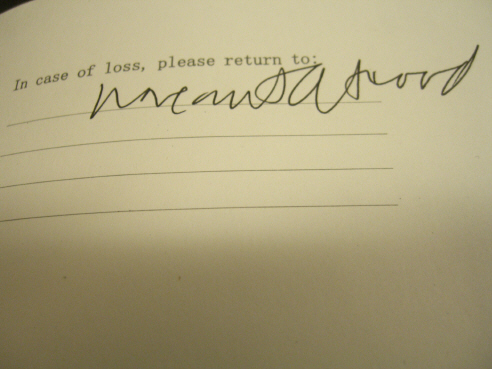
As much as I enjoyed the reading, I declined to buy a copy of Year of the Flood, simply because I’m trying to curtail my purchases of hardback books. I’ll get it from the library. So at the end of the talk, when everyone lined up to get their Margaret Atwood collections signed (one man had a stack of 10 books), I only had my trusty moleskin notebook. But I paid $25 like everyone else, so I wanted my Atwood signature! Gathering my nerve, I handed her my notebook, opened to the inside cover page. To my horror, Atwood began flipping through my notebook, and I hastily motioned for her to sign the inside cover under the “In case of loss” text. She chuckled — yes, I made Margaret Atwood chuckle — and obliged.

margaretatwood

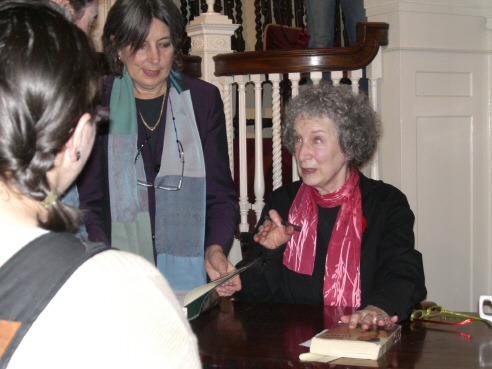
margaretatwood1
Margaret Atwood, First Parish UU, Cambridge, MA

Posted in Culture.

Tagged with , .


Poems for Strangers who I Know

This morning I sifted through a stack of old, abandoned notebooks in which I used to scribble and found a series of vers libre poems filed under the organizing principle “Poems for Strangers who I Know.” I probably wrote them 5-6 years ago and I’m 99% sure that they’ve never seen the light of day (and there’s a probably a reason for that, but whatever. We tend to lose our shame as we age.)

Man on Fort Point Channel Bridge

You walk faster than me, and you never carry an umbrella.
You are bothered by a little rain, tiny drops
Flecked into your matted gray hair,
Targeting your eyes.
But when it pours, you relax your neck, and streams
Run down your face onto the floppy collar
Secured around your neck.

Woman with Sunglasses on the Red Line

You always have a seat in the morning. You
wear a variety of sunglasses with darkened frames.
You sit with precision and boredom, as if daring
the train to crash.

Man Behind the Counter at Central Convenience

You punctuate every sentence with the word “Boss.”
“Good morning, Boss.” “Yes, Boss. “Thank you, Boss.”
I think you are Indian.
You look happy as hell to be selling me chocolate.

Woman with the Leather American Flag Jacket

You work in the copy shop downstairs. You sit outside
next to the doorway of the fire stairs, with
a steaming cup of coffee and smoldering cigarette,
your Leather American Flag Jacket loose
on your boxy frame. You’re a stranger who I know
who I want to know better.

Man at the Harvard Coop Bookstore

You sit in an arm chair, your girth folded
over a book. You read. You turn pages
gently. All the world’s a library,
and all men and women merely commas.

Posted in Culture.

Tagged with , , .


Fed Up

About a month ago, the naked and bound body of a 51-year old part-time census worker in rural Kentucky was found hanging from a tree in a cemetery with the word “fed” scrawled on his chest in magic marker (here). This story shocked me, which is saying something, because nothing shocks me anymore. Like, I was totally unfazed by the whole Balloon Boy saga, in which an idiotic fame-seeking hick perpetuated an ill-conceived media hoax that unraveled due to Balloon Boy himself buckling under Larry King’s gentle probing. Surprised by Balloon Boy? Hell, I’m surprised this sort of thing doesn’t happen with clockwork regularity.

But I am haunted by this dead census worker, killed and hung naked from a tree. It suggests that Red State discontent — stewed under a fire of conservative media, tea parties, and townhall meetings —  is bubbling over into murderous rage. It signifies a muddled, schizophrenic embodiment of “patriotism” that I frankly find terrifying. It harkens lynching. What next, will postal workers be run out of town by venomous mobs? Will burning crosses appear on the front lawns of meter maids?

The FBI is investigating whether this census worker was a victim of anti-government sentiment. Well, it’s either that, or, um… oh heck. I can’t think of a goddamn reason, not even a snarky jokey reason, why someone would hang a census worker and scrawl “fed” on his corpse except for anti-government sentiment coupled with mental derangement, paranoia, and old-fashioned violent tendencies.

In Massachusetts, we don’t have this mentality of lowly government workers being tentacles of the beastly leviathan that is the Federal government. Rather, we see lowly government workers as former D students who cannot be entrusted to consistently exercise good judgment, intellect, or creativity and thus must be restrained by a sprawling bureaucracy that functions quite like a straight-jacket.

But Kentucky, we understand that you’re different. You don’t like the Federal government, with all their fancy “questions” and “statistics.” You don’t want the Federal government sticking their noses into your household to see how many people are there, and how old they are, and if they are male or female, because that’s an invasion of your privacy. But do you have to go and kill the census workers? Can’t you just pretend not to be home, like the rest of us?

Posted in Americana, In the News.

Tagged with .


Take this Job and…

I’ve been dropping hints around it for a few months, but it’s official: Today I accepted a full-time job as a documentation manager for a software company that develops literacy software. Yea for career advancement, personal fulfillment, groovy co-workers, and a brand new Volkswagen Jetta for my suburban commute. (Boo for no more Fridays off.)

My new gig starts in mid-November, but today I alerted my consulting gig of my decision to leave. They countered with an offer for a full-time job, which I immediately rejected, though I offered to continue after-hours consulting in the short-term to get them through upcoming releases. Why not, right? My schedule isn’t batshit insane enough. I’ll sleep when I’m dead.

By the way, my new title – “Documentation Manager” – may imply that I will be managing people, but no. I will be managing documents. (Which are much easier to manage than people, incidentally, because you can burn them and they won’t scream.)

Posted in The 9 to 5.

Tagged with .


The Fruits of Our Constipated Eggplants

This year, our tiny backyard garden produced many heads of crisp n’ tart lettuce and a bumper crop of sweet n’ juicy tomatoes. However, our eggplant crop was atrocious, probably due to the plant’s delayed move from the seed-starting pots to their final resting place in the garden. We should not have waited until the first week of August. The seedlings’ diligent growth in the hot sun seemed promising, but alas, blooms did not appear until Labor Day. And though the warm weather held up through September, the eggplants seemed reluctant to yield any fruit. Then, last week, we noticed a deep-purple bulb cowering under a mess of floppy leaves, and another one on a neighboring plant! Two eggplant fruits, round and squat rather than oblong and smooth, harvested from a total of eight hardy-looking eggplants that are now in bad shape after last Sunday’s snowy Nor’easter.

Honestly, these eggplants don’t look right to me. They look as if they came from very constipated plants.

The Fruits of Our Constipated Eggplants

The Fruits of Our Constipated Eggplants

Posted in Existence.

Tagged with , .


Barbara Ehrenreich Wants You To Stop Thinking Happy Thoughts

Last week I went to see the celebrated writer and activist Barbara Ehrenreich (best known for Nickel and Dimed, her undercover exposé on minimum wage living) talk about her new book, “Bright-sided: How the Relentless Promotion of Positive Thinking Has Undermined America” (here on Amazon). Yes, that’s right, someone finally wrote a book about the banality of positive thinking. So flush the happy pills down the toilet and get in touch with your inner sourpuss!

The fact that this sounds so evil only supports Ehrenreich’s contention that America’s insidious “mandatory optimism” has turned us all into soul-leeched smile zombies (my words, not hers). As Ehrenreich said, “People wonder how I can take a stand against positive thinking. It’s like taking a stand against world peace, or motherhood, or Ellen DeGeneres.” (Actually, I’m sure thousands of God-fearing Americans would take a stand against Ellen DeGeneres, but they probably weren’t sitting in the audience at the Brattle Theater in Cambridge, Mass.)

But what Ehrenreich argues against is not positive thinking per se, but the ideology that everyone must be happy, and if you’re not happy, something is wrong with you. Ehrenheich’s crusade against the cult of positive thinking began when she battled breast cancer in the early 2000s. She was angry, because she wanted to know why she got breast cancer, she wanted to know why the survival rates are dismal, and she wanted to know why the treatments are so horrific. But what she got from the cancer support groups were pink ribbons, teddy bears, and reassurances that positive thinking could cure cancer, a claim that Ehrenreich says is unsubstantiated by research (and substantiated somewhat by the fact that Ehrenreich survived breast cancer despite not viewing cancer as a “life-changing growth experience.”)

Ehrenreich began to notice this “happiness industry” that uses positive thinking to prey on people, emotionally and monetarily. From “Life is Good” t-shirts to inspirational knickknacks to motivational speakers to self-help books to megachurches, all of these speak to the belief that there is not problem that cannot be solved by changing your thinking. Need a job? Positive thinking! Need money? Positive thinking! Have cancer? Positive thinking!

She holds up George W. Bush as the perfect example of the dangers of optimism. GWB could not stand to have pessimists around him, he dismissed generals who warned about possible doom in Iraq, and he ignored any hint that the economy could collapse. Bush just beamed optimism. Even when his Presidency was in shambles, he remained convinced that history would vindicate him, which is so optimistic as to be batshit delusional.

What Ehrenheich advocates as an alternative to optimism is not pessimism, but realism. Realism won’t make you happy, but you can’t have happiness without it. If we truly want to alleviate poverty and unemployment, we have to stop hoping it will get better and start making it better. If we truly want to help cancer sufferers, we have to stop waving around commercialized pink ribbons and start asking tough questions about the causes of cancer. America has an international repetuation as ‘artifical optimists,’ but as Ehrenheich jokes, “I’m positive that we can overcome it.”

Posted in Culture.

Tagged with , , .