Skip to content


Cusco to Puno

So we were still in Peru. We had seen Cusco and the Sacred Valley, and then we spent one, two, three days on the Inca Trail to arrive at Machu Picchu. I’m sure you’re wondering what else we could have possibly done in Peru, because what else is there?

It turns out… not that much, relatively! But we saw it anyway!

The day that we visited Machu Picchu, we arrived back at our hotel in Cusco at 11:30pm. We woke up the next morning at 5:45am in order to pack, shower, eat breakfast, and take a taxi to the bus station, where we boarded a luxury double-decker tourist bus to Puno, a major city on the shore of Lake Titicaca. 5:45am?!? Pish, by the standards of the rest of our vacation, that’s sleeping in.

The tourist bus would make 5 stops on the 280-mile trip to Puno, making it an all-day affair. We didn’t mind, though. We were so physically exhausted that we just wanted to be ferried around and told what to look at.

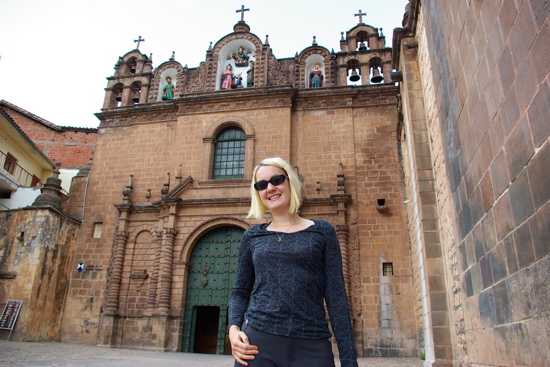
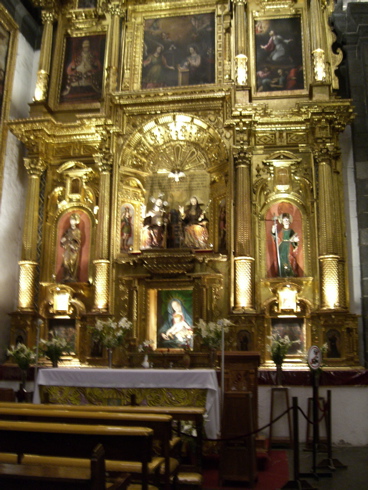
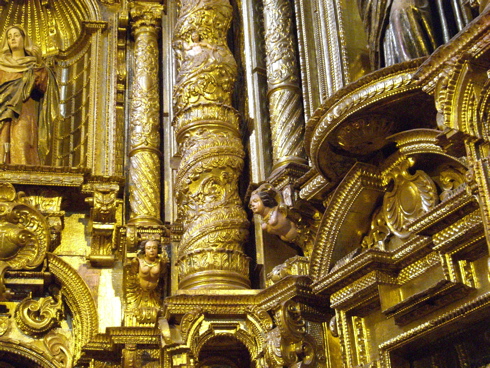
The first stop was a Catholic church in Andahuaylillas, which according to our guide is called the Sistine Chapel of Peru — a rather ambitious pronouncement, because the only similarity is that the walls and ceiling are painted. We couldn’t take pictures in the church, but here is the exterior and the surrounding market.

Church at Andahuaylillas

Tourist Market at Andahuaylillas

The bus journeyed onto stop #2 in Raqchi, where we toured the Temple of Wiracocha, a massive Incan structure that formerly boasted a famously large roof. The typical Incan foundation supports adobe walls; our guide explained that the local stones were too volcanic and soft, so adobe was used. The round structures served as supports for the slanted roof.

Temple of Wiracocha

As we toured the temple grounds, we passed a group of anglo New Agers, standing in complete serene silence with their fingertips extended to better receive some of that sacred Incan energy from the temple’s ruins. I hate to sound unenlightened, but they looked pretty freaking ridiculous.

Temple of Wiracocha

Near the temple was a vast complex of about 100 stone storehouses, used to silo grain. These are unique in Incan architecture because storehouse were typically square, not round.

"Silos" at Raqchi

The condor, puma, and snake are three of the most important animals in Inca mysticism. The snake represents the underworld, the puma represents earth, and the condor represents the heavens. Here they are pictured on a Chakana, or Inca cross.

Condor, Puma, Snake on a Chakana

Lunch counted as stop #3. It was a typical tourist buffet that seemed particularly exciting to me after eating family-style meals on Inca Trail. I could eat as much alpaca as I wanted.

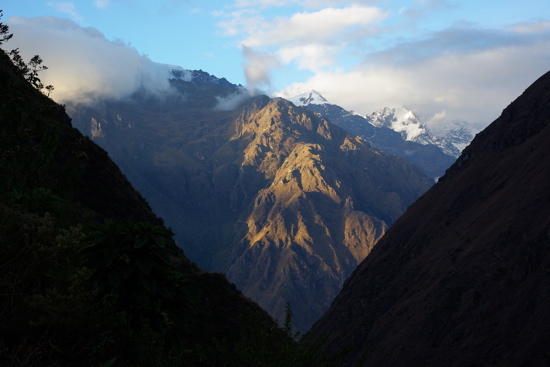
After lunch, the bus made stop #4 at La Raya. The only attraction at La Raya was the magnificent mountain view at 4335 meters above sea level, which I believe is the highest on Earth I’ve ever been in my life.

Fabric for Sale at La Raya

La Raya

Our last stop was at the Pukara musuem, which has a number of artifacts from the Pukara era (pre-Incan society).

Pukara Museum

Pukara Church

The town is famed across Peru for producing the “Toritos de Pucara,” which are little clay bulls that many residents place on their roofs for good luck.

Toritos de Pucara

By then, the fatigue of my largely-sleepless trek on the Inca Trail was catching up to me, and I eagerly climbed onto the bus to doze the rest of the way to Puno. “Huh? Oh, look, it’s Lake Titicaca. That’s nice.” The rest of the night was a blur — we arrived in the Puno bus station, where our hotel picked us up and brought us to a very large room with excellent cable TV. I laid in bed, almost too exhausted to go eat dinner but not quite. We wandered down Puno’s main street and had very nice local fish with wine that cost $30USD. And then, bed.

Posted in Trips.

Tagged with .


Something’s Groton in Massachusetts

We went for an early-autumn bike ride on the Nashua River Rail Trail, which travels 11 miles from Ayer through Groton and up into New Hampshire. And speaking of early autumn, it certainly is! Owing to the dry, sunny summer, there are more than a few patches of bright reds, oranges, and yellows dotting the forestscape. Acorns are falling, the fauna is restless, and the light seems subdued. And so ends another summer.

Winter is an etching, spring a watercolor, summer an oil painting and autumn a mosaic of them all. ~Stanley Horowitz

Posted in Massachusetts.

Tagged with , .


Book Review: Ice Ice Ice, The Extraordinary Vanilla Ice

My local library is collecting donations for a fund-raising used book sale. What an excellent excuse to go through my towering stacks and cull the tomes that I will never, ever pick up again. I like the idea of owning paperback books by the likes of Katherine Anne Porter, Jack London, Daniel Dafoe, Simone de Beauvoir, and Victor Hugo, but I must admit to myself that if I am someday compelled to re-read, say, Of Human Bondage, I should go to the library and get a version without a cracked spine that doesn’t smell vaguely of mildew. To the donation pile you go!

Yet for all of the fine literature that I rid myself of, I somehow could not stand to part with this:

I am really at a loss to explain how, when, where, and most importantly WHY I acquired Ice Ice Ice: The Extraordinary Vanilla Ice (an “unauthorized biography” published in 1991). It definitely came into my possession sometime before college, and I assure you that my interest in the book and its subject was purely in snide jest and not out of fandom for Vanilla Ice, whose contrived rap-pop is the sort of bubblegum bullshit that I had long evolved past. In fact, this seriously great picture sums up how I have always felt about Vanilla Ice: the girl on the right is outrightly laughing in his face, while the guy on the left is looking at Ice like he’s a total fucking idiot.

Dear lord. He looks like a newbie in a yoga class.

For whatever reason, I couldn’t bring myself to donate this book to the library without reading it just one last time. Actually, I don’t believe that I have ever read this book before, or maybe I’ve blocked it out. The book’s introduction seeks to establish Vanilla Ice as a musical act worthy of an unauthorized biography by extolling his musical hits (“Ice Ice Baby” and “Play That Funky Music”) and, based on these successes, comparing him to Madonna, Prince, and Michael Jackson. Then, the book launches into some very alarming diction:

That totally reminds me of the time when my seventh-grade math teacher tried to “speak our language” by repeated saying the word “awesome.” Who could have possibly written this, you wonder? Why, famed celebrity biographer Mark Bego:

The first chapter hits all of the burning questions that fans must have about Vanilla Ice (who is alternately called both “Vanilla” and “Ice.”) What was he like growing up? (He was ‘a kid that grew up in the ghetto’.) What’s his real name? (“I’m from the street — that’s why I don’t give out my name.” How does he feel about his audience? (He has the “ability to cure his audience like a rapping witch doctor.”)

The rest of the book expounds on these themes, revealing that Ice claims to be “part Apache. I am also part Cuban, but other than that I’m really not sure.” Surely any self-respecting unauthorized biographer would investigate these claims a little further, but the book quickly moves on to Vanilla’s realization that other white people couldn’t dance and rap as “naturally” as he could due to his “ghetto” upbringing. But the ghetto wasn’t all cold kickin’ it and rockin’ the house. Having been stabbed 5 times and forced to conceal his true identity to keep old gang rivals from finding him, the Iceman would caution any of his fans who are thinking of joining a gang: “Negative! I’d say, straight from the heart: stay off the streets. It ain’t cool. The gang stuff ain’t cool, take it from Vanilla Ice.” Since he was in it, he knows what he’s talking about.

The book does not shy away from the many, many controversies surrounding Vanilla. After all, this is an “unauthorized” biography. But Vanilla claims that he never called himself “the Elvis of Rap,” he never lied about what high school he went to, he never distorted his Motocross accomplishments, he never dissed tour-mate MC Hammer, he hid his identity to protect his mother, and his raps aren’t soft or inauthentic. Over and over.

Jesus. After 99 pages of this crap, whatever lunacy that compelled me to hold onto this book melted away into a puddle of water. Sort of like Ice did.

Posted in Review.

Tagged with , .


It’s Only a Rock N Rock Half Marathon

I quit running about a year and a half ago. The perpetual grind of training and racing was an unsustainable juxtaposition of physical stress and mental tedium… in other words, I was sick and tired of running! I wanted to engage in exercise that would harness my body and my mind while staying the hell away from my plantar fascia. So I quit running and I didn’t really miss it. Oh, I felt a pang of nostalgia when I’d accompany Mr. P to races, but I was content sweating on a yoga mat, taking outdoor walks with my French podcasts, and reading the New York Times while pedaling away on a spinning bike. And my life seemed to get just a little bit less Type A.

And then, one day this past summer, I was hiking in the Middlesex Fells, feelin’ pretty energized, when I spontaneously started to run. I was hopping over rocks, ducking under branches, skimming up hills and floating down hills. I was running, and it felt pretty good. Plus, I reasoned that being able to run is an evolutionary beneficial skill that could save my life, if my life suddenly emulated an action/thriller movie.

I wasn’t really prepared to run a half-marathon, but I signed up for the Philadelphia ING Rock N Roll Half Marathon (which occurred yesterday) anyway. Mr. P was running it. My 67-year old mother was running it. Hell, I can run any distance, once. I wasn’t completely sold on the idea of re-becoming a runner, so I didn’t train beyond running 6 miles about once or twice a week in the months leading up to the race. Instead, I focused on training my body to carry heavy things up steep trails, which does bestow excellent aerobic capacity but is quite a different skill than running on a flat place of concrete for 13.1 miles — an activity that puts a massive amount of stress on a very particular set of muscles. (Yes, I know that running a half-marathon without training for it goes against all common sense and I wouldn’t recommend it unless you regularly engage in insane physical feats).

Mr. P at the Finish Line

I admit: It was the whole “Rock and Roll” angle of the race that compelled me. But I quickly found out that the ING Rock N Roll races are not worth running for the music; it’s just branding, a reason to charge $90 per person under the premise that the Rock N Roll will enhance the running experience. Three of the bands that I ran past weren’t even playing (two had just finished songs and were shuffling around the stage, while one was mysteriously blaring Bruce Springsteen’s “Born to Run” from loudspeakers.) If they were playing, well, we’re running past them and can maybe absorb 30 seconds of music. The best band that I passed was playing an Interpol song — sneaky ploy, these ones, playing an awesome song from an awesome band that 98% of the runners have never heard. Much more enjoyable were the simple, folky combos that set themselves up informally along the route to inject a minute of catchy jazz or bluegrass into my run.

Me at the Finish Line

Despite being completely cognizant of my ill-preparedness, I am still rather stunned and abashed by my poor performance. I made it to Mile 8 feeling pretty good — not a surprise, since my “training” runs were 6 miles. Around Mile 9, my legs started sending me signals that they wanted to stop, so I started alternating walking with running. By Mile 12, I was completely walking, but I was determined to run across the finish line. My chip time was 2 hours, 31 minutes and 12 seconds, meaning I averaged 11 minutes 32 seconds a mile. In terms of my place:

Overall: 12417 out of 15411 · Division (females 30-34): 1207 out of 1603 · Gender: 6403 out of 8641

“That is horrible!” I moaned to Mr. P. “My lord, I finished in the bottom quarter of my division!”

“But you didn’t train at all,” he reasoned with me. “You go running once a week. You haven’t run more than 10k in almost 2 years. And still, you finished ahead of 400 women in your age group!” Considering that’s true, I have to wonder how they were training.

(Anyway, the real winner was my 67-year old mother, who finished 8th in her division out of 20 and was right on my heels at 3 hours. Obviously she was rocking and rolling.)

Posted in Existence.

Tagged with , , .


Machu Picchu (The Inca Trail: Day 4)

My vexing insomnia continued into our final night on the Inca Trail. I did manage a few hours of fitful sleep before midnight, but subsequent to nothing my eyes were wide open and my mind active. Occasionally a light drizzle pattered on the roof of the tent, though the night was largely absent of downpours, giving me a glimmer of hope that the next day at Machu Picchu would be rain-free. Oh, I didn’t care about the clouds, the wind, the gray bleak sky. I didn’t even care about the past two days of relentless precipitation, so long as it’s not raining at Machu Picchu. I prayed to Pachamama, the only Incan deity I know by name, even though Pachamama is the Earth goddess and probably has little control over the weather.

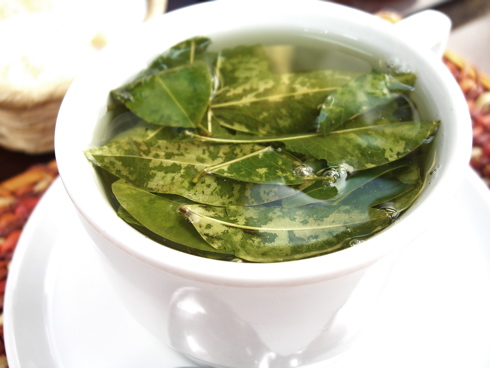
Sometime over the course of the night, it occurred to me that my insomnia may have resulted from all the mate de coca tea that I had been drinking in order to stave off the shivers from wet clothes. Every time I turned around, there’s a porter with a tea kettle and a basket of coca leaves. Since I gave up coffee two years, I really don’t take much caffeine aside from the negligible amount in my daily green teas, but I was beginning to suspect that this mate de coca stuff was loaded with stimulants. I mean, this is the raw material for cocaine, I’m drinking six cups a day, and I wonder why I can’t sleep?

Whatever. The porters would come wake us up at 3:45am, but the Connecticut ladies in the adjacent tent set their alarm for 3:30am because they always need extra time in the morning. So I was up and putting in my contacts as weak groans emitted from Mr. P’s sleeping bag. “It’s Machu Picchu time!” I whispered/hissed. “This is your dream, right?”

Yes. You see, this whole trip — Cusco, the Inca Trail, Machu Picchu — was all Mr. P’s dream. I noticed that among the other couples in our group, there was always one person who championed the Inca Trail trip and one person who went along with it and now blamed their partner for the horrible hiking conditions that befell us. “We could’ve gone to Hawaii,” the Vancouver boyfriend moaned at the previous day’s lunch, as the tent shook and leaked on its soggy occupants. The Vancouver girlfriend hung her head and said, “I know, I know. Don’t worry, you’re picking our next vacation.” Strangely, I did not harbor such resentment towards Mr. P, because even though it rained, I still loved every minute of the trek. The rain was disappointing, but it’s not something anyone can control. I was determined to enjoy myself despite the weather, so Mr. P had damn better show equal determination.

The porters set up a small breakfast for us: Slices of untoasted bread, crepes, and hot beverages. It was 4am and no one was really hungry, but it would be a long day that would probably require carbs. After breakfast, our group grabbed our backpacks and walked about 5 minutes to the gate to Machu Picchu (not the main gate, but the “back-door” gate accessible only by the Inca Trail). It was 4:30am, one hour before it opened, and we were second in line behind a small group of Brits. Our place secured, most of the group headed off to the bathrooms. I lingered around, intially trying to make small talk with the unwilling Brits. (This group of horrible Brits — a posh mother with her two grown children — would wind up haunting Mr. P and I for the rest of our time in Peru.)

By 5:30am, there were probably about 200 people waiting to enter the gates to Machu Picchu. The horrible Brits were admitted promptly at 5:30am, and then our group followed. It was about a 90-minute walk from the gate to the famed Sun Gate, where Machu Picchu can be viewed with the sunrise. Our guide Will walked rapidly, more rapidly than ever before. We quickly passed the horrible Brits and kept our lead all the way to the Sun Gate, which we reached around 7am to find:
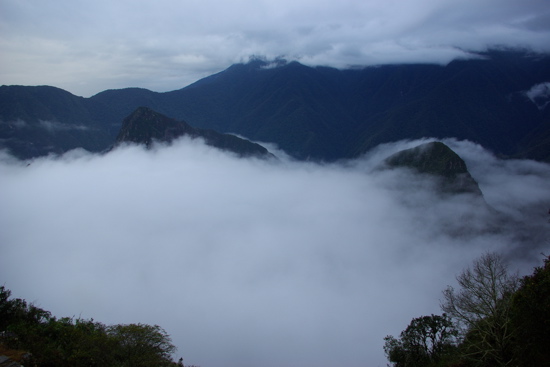
What Should Have Been Our First View of Machu Picchu from the Sun Gate

Though the rain had mercifully ceased, we still had clouds to contend with. Other groups filed into the Sun Gate, disappointed to find Machu Picchu totally obscured. We posed for a group photo anyway:
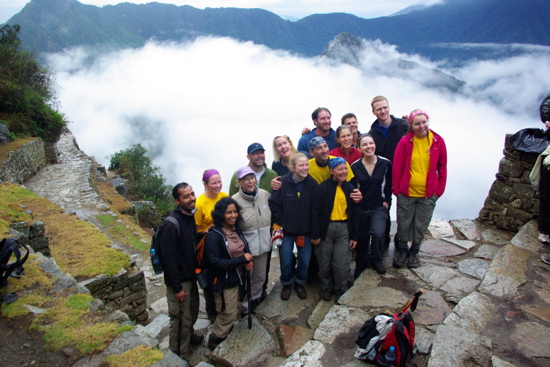
First Group at the Sun Gate

We pressed onward to get closer to Machu Picchu, and hopefully at an unblocked vantage point. 10 minutes later, we emerged on some ancient farming terraces to finally glimpse our prize:
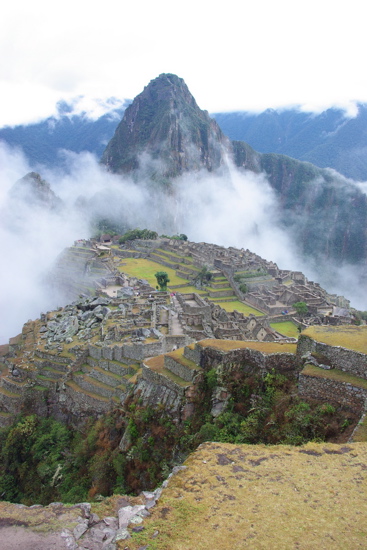
Machu Picchu

Holy mackerel. There it was, where it has always been, and it was magnificent. It was a city, vast and teetering on a precipice, stalwart yet crumbling, beautiful yet barren, swathed in cloud as if it wished to remain secluded.

Our joy was palatable. All the rain, all the shivers, all the sleepless nights faded to trifling matters that had happened in another lifetime.
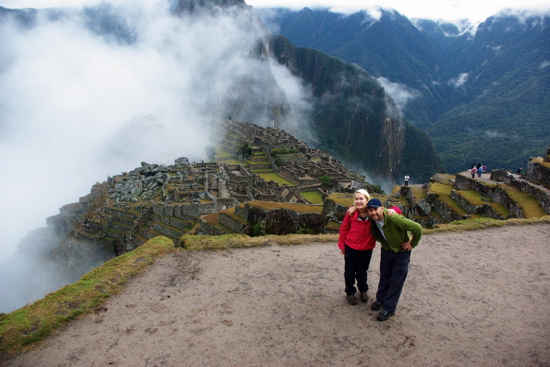
Machu Picchu
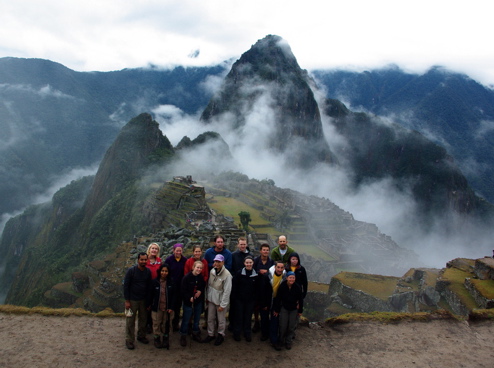
Group Photo at Machu Picchu
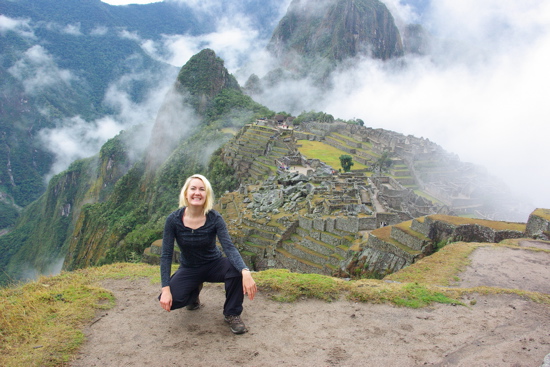
Machu Picchu
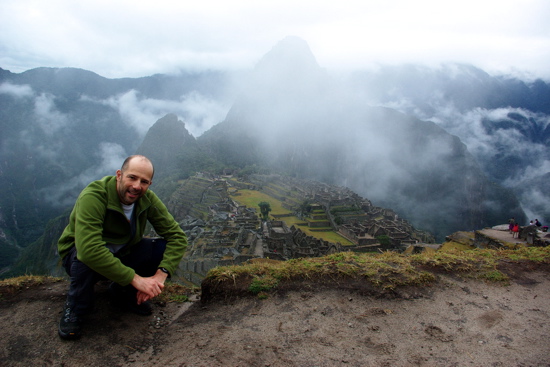
Machu Picchu
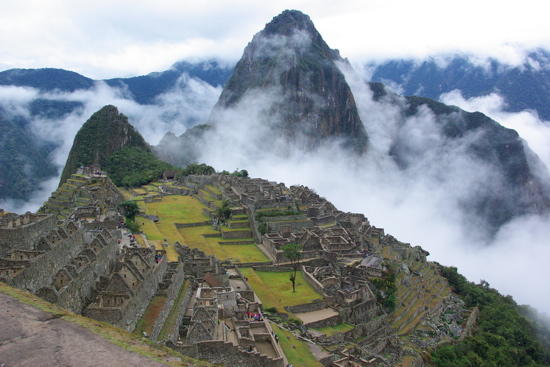
Machu Picchu

After our group got its fill of long-range photos, we descended down to the gates of Machu Picchu to use the restrooms, store our packs, and get our offical tickets. As we made our way down the trails, we began encountering day tourists who had come to Machu Picchu by way of train and bus. We were all immediately struck by how clean and nice they all looked. In comparison, we felt like swamp creatures.

Will the Guide took us for a tour of Machu Picchu. I won’t even try to narrate what we saw because it was all so overwheming that I can’t recall most of it.
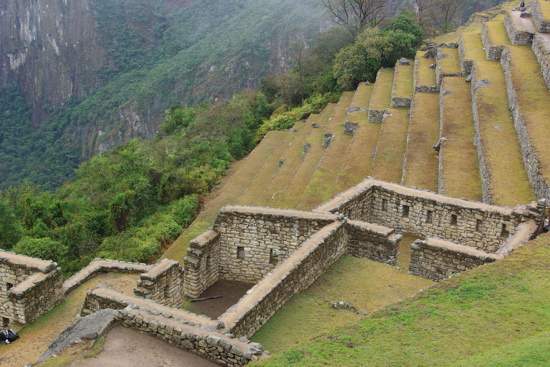
Machu Picchu Farming Terraces
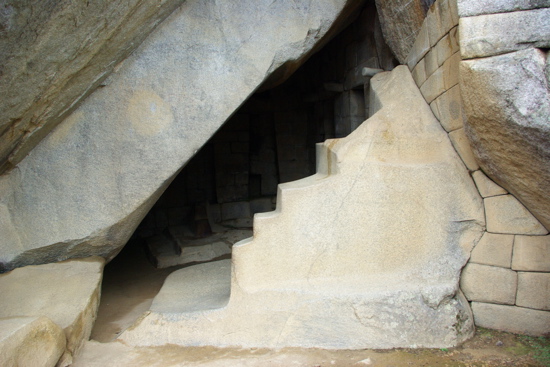
Machu Picchu — Temple of the Sun
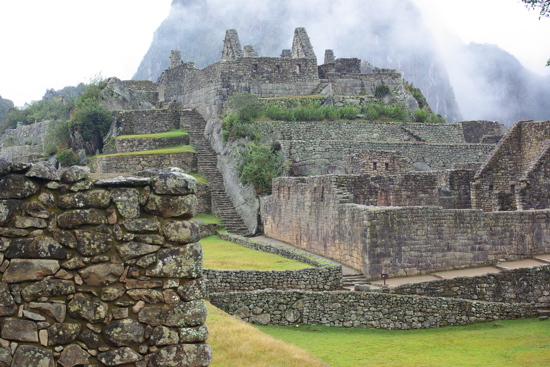
Machu Picchu
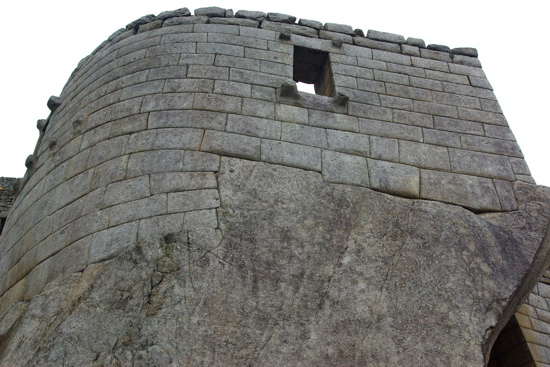
Machu Picchu — Temple of the Sun
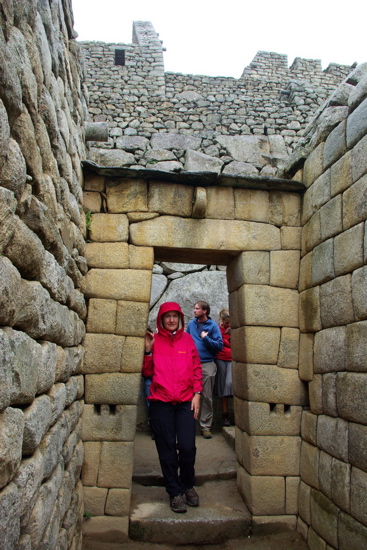
Machu Picchu
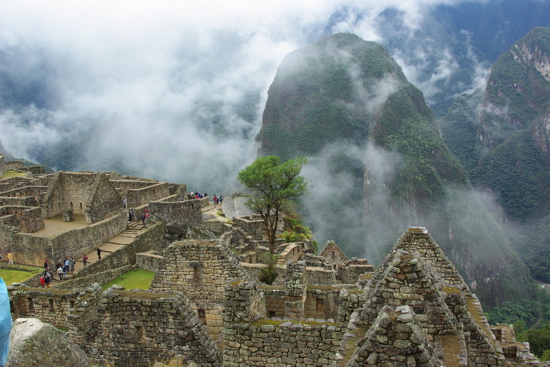
Machu Picchu
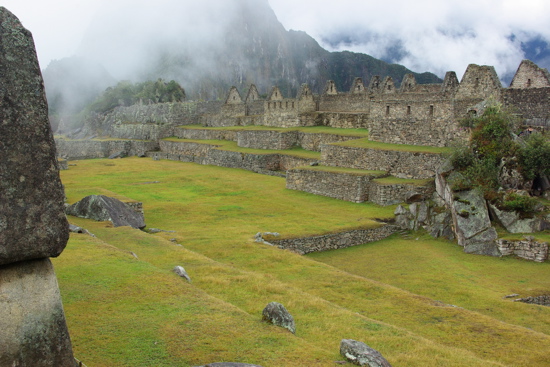
Machu Picchu
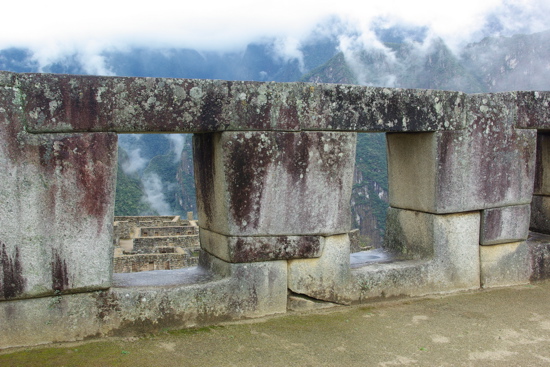
Machu Picchu
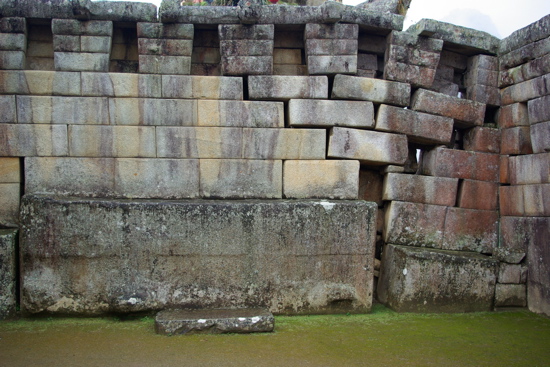
Machu Picchu
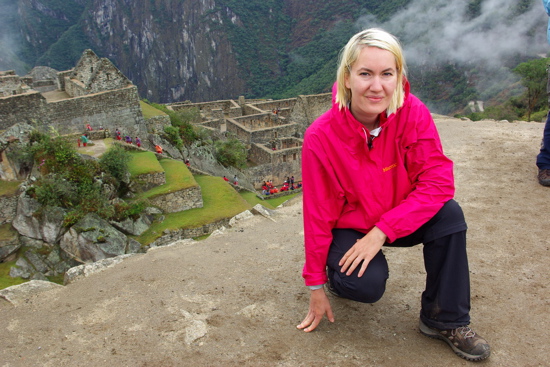
Machu Picchu
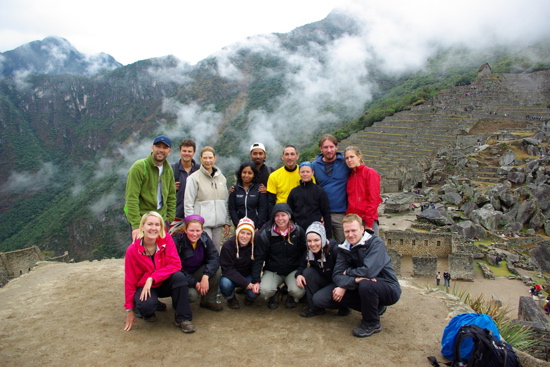
Machu Picchu — Last Group Photo
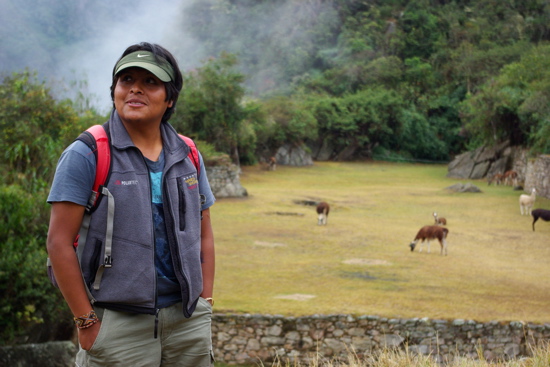
Will, Our Guide

After the last group photo, Will let us loose on Machu Picchu for a few hours, with explicit instructions on how to get to a restaurant in Aguas Caliente for our celebratory lunch. First, Mr. P and I mingled with some of our group near the grazing llamas.
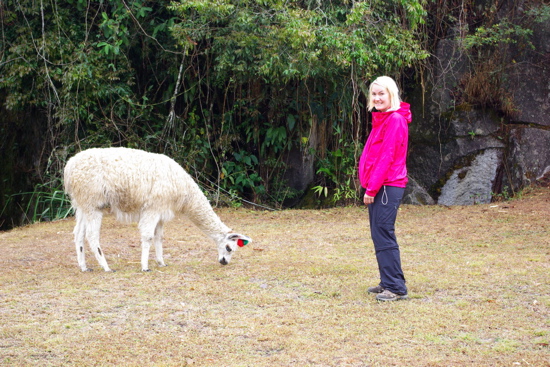
Llama

The nutty New Zealander decided to see if llamas could be mounted. It looks like he’s giving the llama a kick, but really, he just tried to jump on its back.
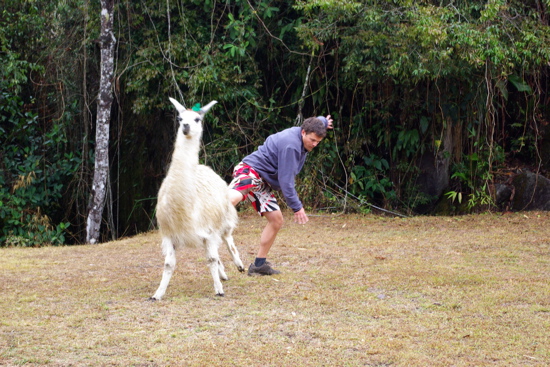
So Punk Rock

Someone yelled “Stop bothering them!” and we all exploded into laughter. Good times, with llamas!

At that point, Mr. P and I separated ourselves from the group so Mr. P could concentrate on taking pretty pictures.
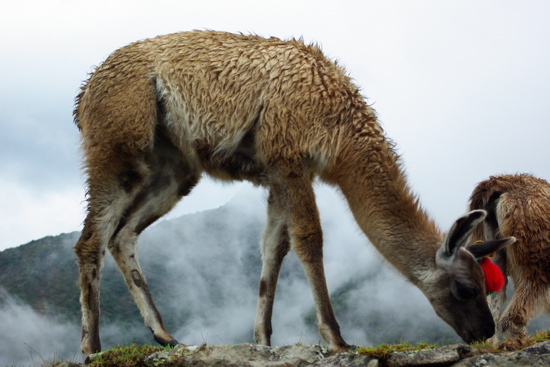
Machu Picchu Llama
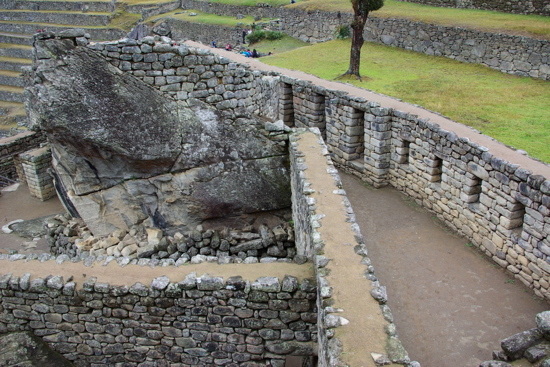
Temple of the Condor
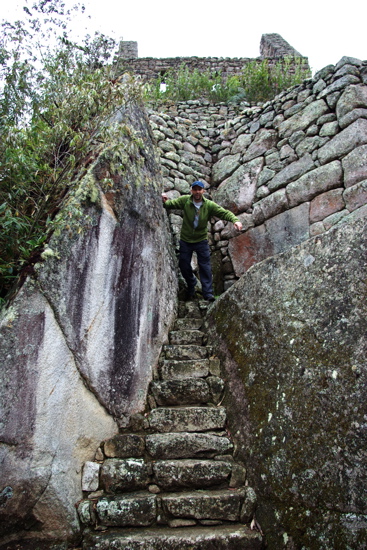
Machu Picchu
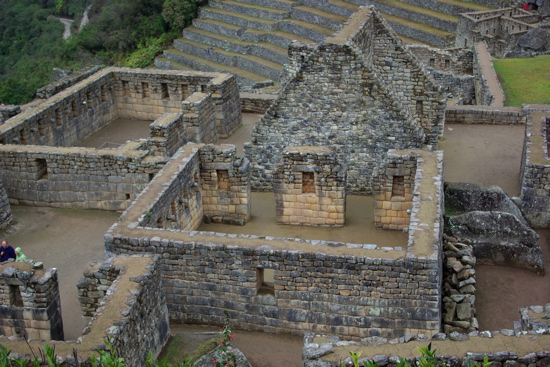
Machu Picchu
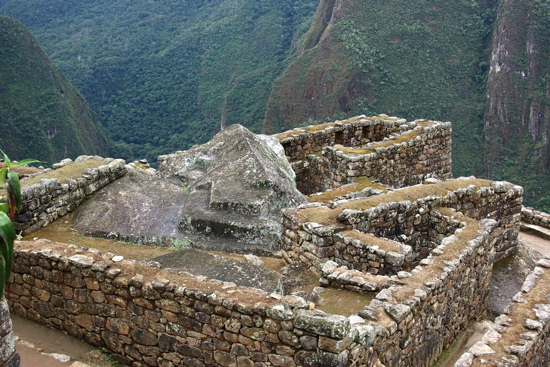
Machu Picchu

One thing that I loved about Machu Picchu is how the Incas intergrated nature into their architecture.
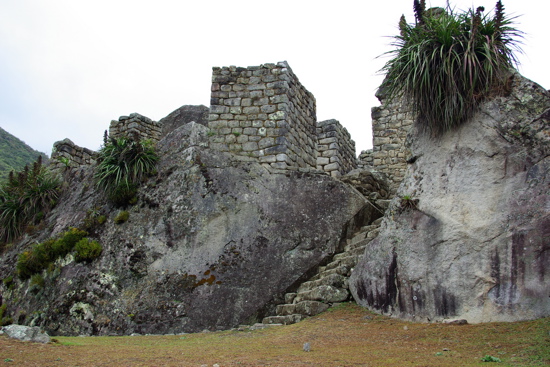
Machu Picchu
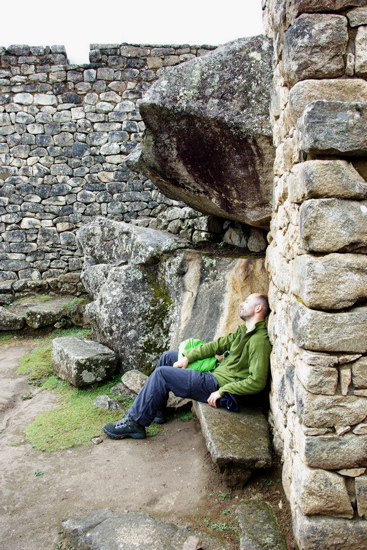
Machu Picchu

With about 45 minutes to go, we decided to go see the Inca Bridge. We met some members of our group coming back from it and they didn’t seem to impressed by the bridge, but we decided to go anyway.
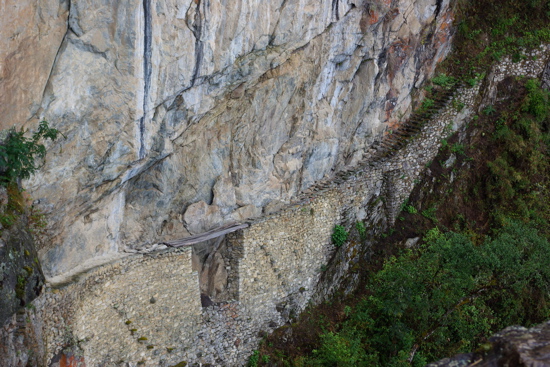
Inca Bridge at Machu Picchu

It was insanely steep and narrow. Jeepers. I refused to go near it, but Mr. P ventured on.
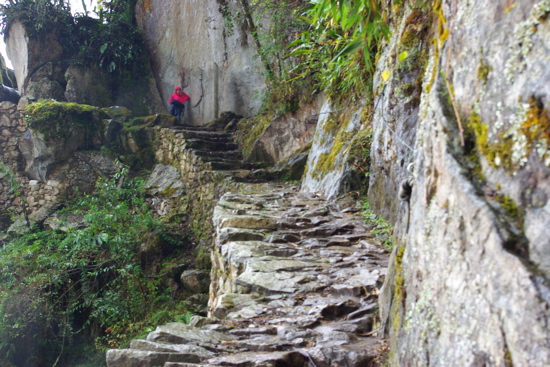
Inca Bridge
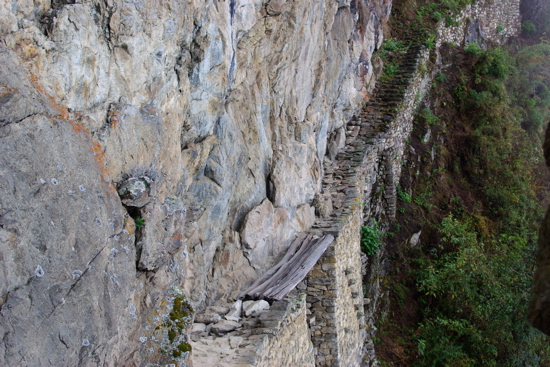
Inca Bridge

By then, we were sort of late for lunch. We left Machu Picchu and boarded the shuttle bus to Aguas Caliente, which took us down a winding road to the town. The rest of our group was already sitting down for lunch, except for the nutty New Zelander, who had decided to climb Wayna Picchu. He showed up 20 minutes later, bragging of his exploits even though he couldn’t see a thing from the top. We ordered pizza and beer, collected the tips for our guide and assistant guide, and elected the New Zealander to give a speech of appreciation. He stood up and began ranting incoherently about the rain. “What kind of a speech is this?” I whispered to one of the Brits. “Exactly the kind of speech we knew he’d give!” she whispered back.
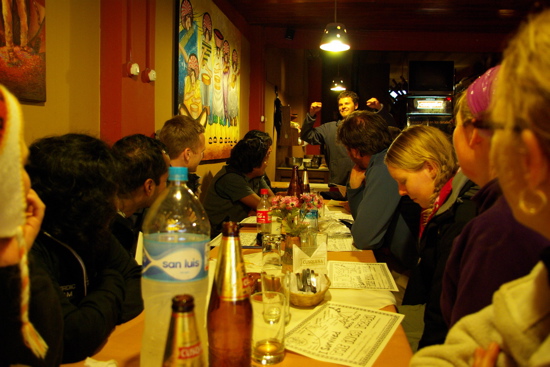
Speech!

After lunch, some people in our group decided to take the early train back to Cusco, while the rest of us went to the famed hot springs of Aguas Caliente to unwind in the pools for a few hours. This was my favorite part of the whole trek — bobbing around the hot water, laughing with everyone about our misadventures, and watching the sun light up the early evening skies. Fucking sun!
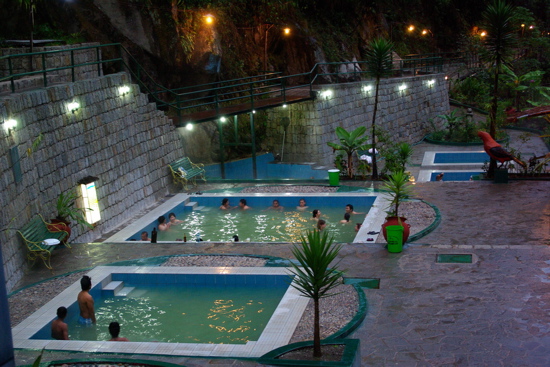
At Aguas Caliente

Regrettably, it was then time to return to Cusco. We met our guide back at the restaurant, grabbed our packs, and headed for the “backpacker” train back to Ollantaytambo. From there, we boarded a private bus back to Cusco. Within 5 minutes of getting on the bus, I fell asleep. Deeply asleep. Apparently the bus driver was driving like a maniac and everyone was laughing and talking, yet I slept profoundly. When I woke up, we were in Cusco and it was time to go back to our hotel. We hugged our goodbyes and hiked briskly uphill to our hotel. Where, again, I slept like the dead.
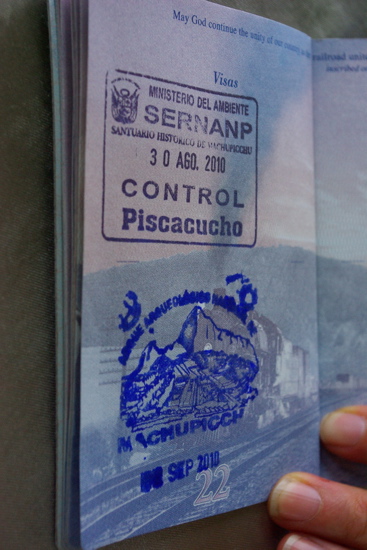
Machu Picchu Passport Stamps
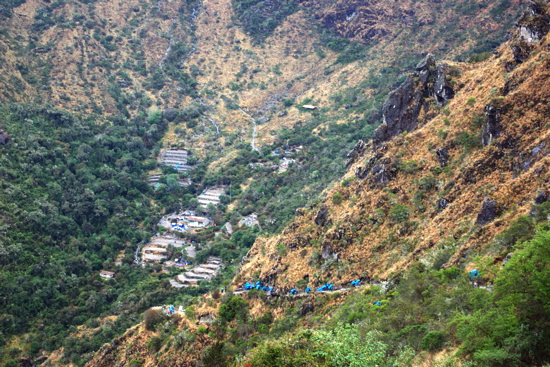
Posted in Trips.

Tagged with , .


The Inca Trail: Day 3

The rain continued for the duration of our second night on the Inca Trail — periodically abating, and then rearing up, and then abating in 5 minute intervals. I twisted my body around in my sleeping bag, struggling to find a position that didn’t grind my hips into the rock-hard mattress pad.  I circled through my repertoire of surefire sleep inducers — I engaged in deep breathing through my nose, I counted my breathes and the breathes of those around me, I mentally relived plots to old sit-coms like Family Ties and 90210, I stretched out my spine as long as possible, and I tried to completely blank out my mind. But neither the rain nor my discomfort was the cause of my insomnia; I simply was not tired.
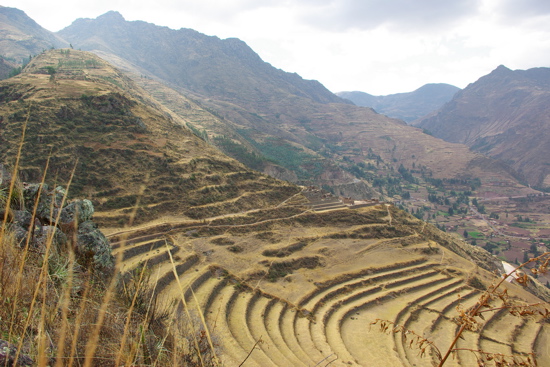
Raoul the Assistant Guide came to our tent with the tea-bearing porters at 5:30am. The night before, Will the Guide regaled our rum-drinking group with Inca Trail ghost stories, including one about the namesake dead woman of the Dead Woman’s Pass, and he advised us to avoid any undue nighttime hauntings by leaving an offering to her spirit outside of our tent: “She likes Milky Ways.” We left an apple. When we emerged for the tent, the apple was gone, presumably taken by Raoul.

Breakfast was another carb fest involving porridge, bread, and pancakes. Today would not be as hard as Day 2, but it would be long, with no mid-morning snack to see us through to lunch. The rain was light yet the clouds were heavy and dark. We started straight-away with a climb to the second pass. Here’s a view of the terraced campsite where I could not sleep, with a line of porters following us up the pass.

View of 2nd Campsite (Terraces) and Porters

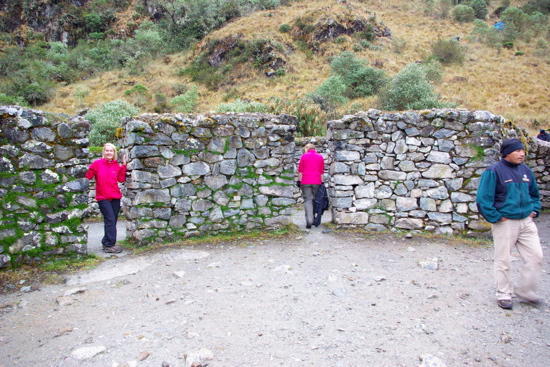
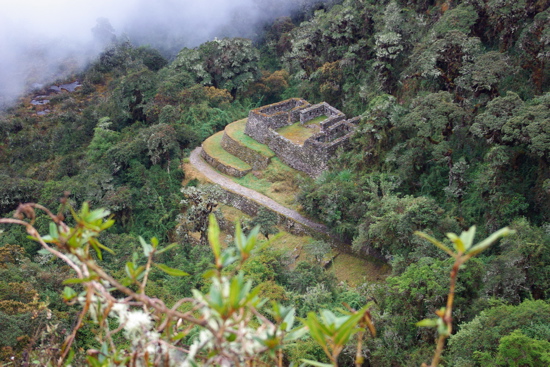
Our group paused briefly to explore Runcu Raccay, a small circular Inca site that was probably used as a rest stop for passing travelers and/or as a strategic watchtower. It served both purposes for us as well. The rain stopped, to the happiness of all.

At Runcu Raccay Inca Ruins

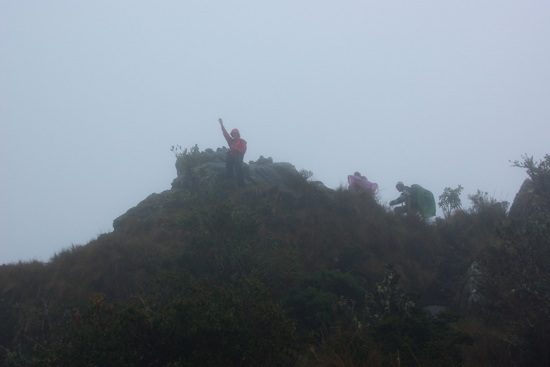
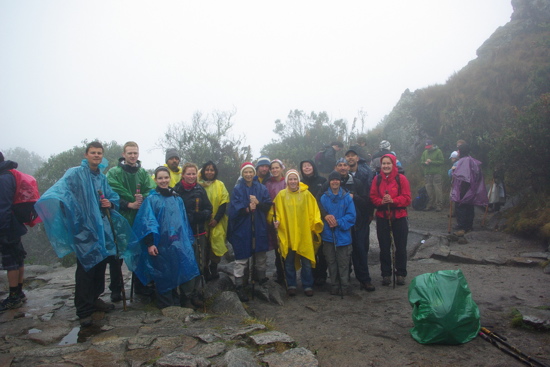
We continued up the second pass, and it grew cloudier and started to rain again. Our guide Will advised us to carry a rock to deposit on a cairn at the top of the pass while making a wish. I climbed to a small hill to place my rock and make my wish, and then we had a group photo. Don’t we look thrilled?

Making a Wish at the Top of Second Pass

Group Photo at Second Pass

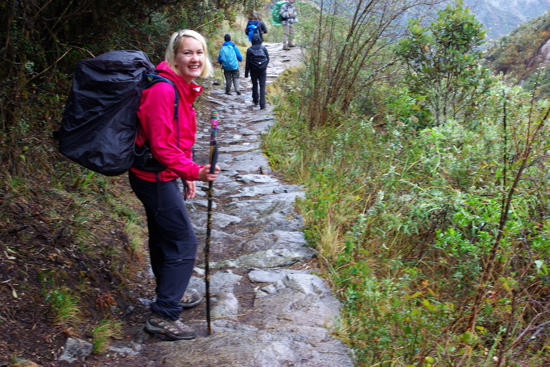
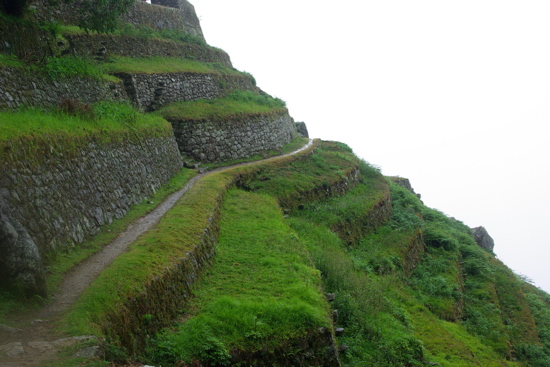
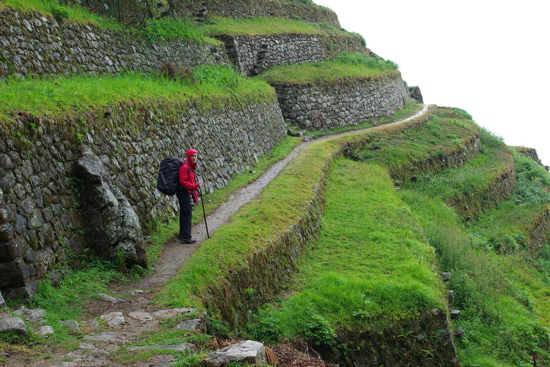
Soon after we descended the second pass, the rain stopped and the dreaded sun flies converged (imagine gnats that bite). We strolled easily along, occasionally chatting with other members of our group, occasionally stopping for a photo, always marveling at the finely-engineered trail upon which we walked.

(Notice how shiny-clean my hair looks considering it had been 3 days since my last shower? Thanks, insane unseasonable rain!)

Descending the Second Pass

Inca Trail

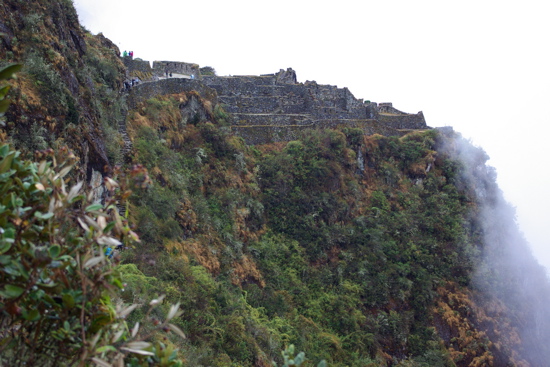
View of Inca Ruin Sayac Marca

Looking down on Sayac Marca

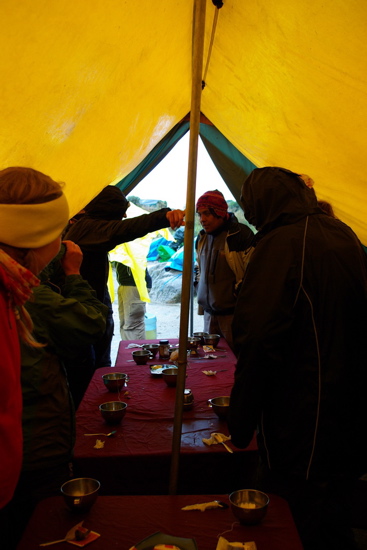
Soon after we passed the ruins of Sayac Marca, it began to rain. Hard. With wind. We hurried to our lunch site, which we reached at 11am. The porters set up a tent for us to throw our bags in and then we rushed into the lunch tent, where we sipped tea and waited for the remaining members of our group. Spirits were definitely low as the wind shook the tent and rain began to drip from the ceiling. Many people were wearing their last set of dry clothes. Some girls, including me, couldn’t stop shivering. Everyone couldn’t believe what a wet disaster the Inca Trail had turned out to be.

It’s really hard to overstate how profound an effect the rain had on our trek. I mean, this isn’t North America, when rain has pretty much an equal chance of occurring on any given day of the year. In Peru, there is a rainy season (Oct through April), when it rains pretty much every day, and a dry season (May through September), when it rains less than an inch per month. So, despite being conscientious tourists and paying high-season prices for dry-season conditions, we had the profound misfortune of hiking the Inca Trail during an aberrational climatic blip. The joke around the lunch tent was “If this is the dry season, I wonder what the rainy season is like?”

Please Don’t Make Us Leave the Tent

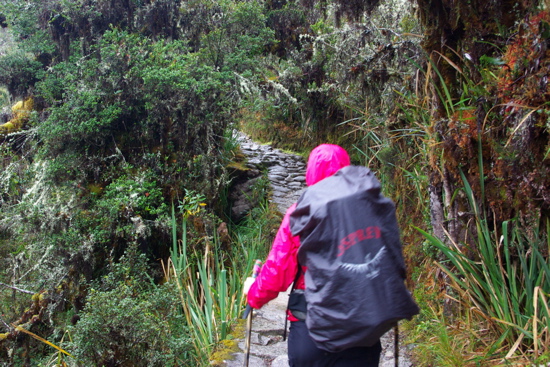
After another carb-monotonous lunch (“Oh look, potatoes,” I said with overly-feigned surprise as I passed a platter of fried steak and potatoes down the table. “To go with your rice, pasta, and bread,” one of the Brits quipped.) it was onward, and downward. The rain sucked, but it did not lessen my appreciation of the Inca Trail. The vegetation started to grow more jungle-like and exotic.

Inca Trail

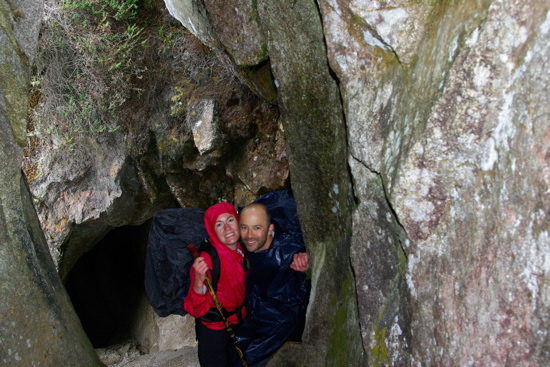
The Inca Tunnel — a famous place for pictures.

Inca Tunnel

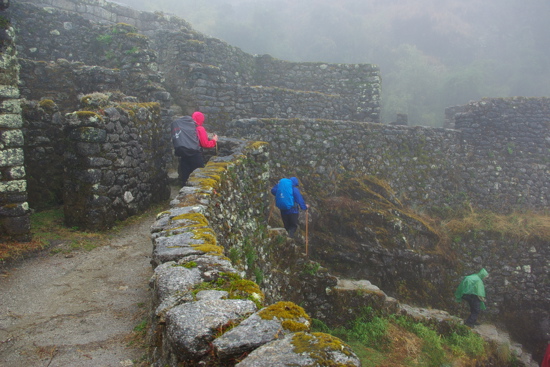
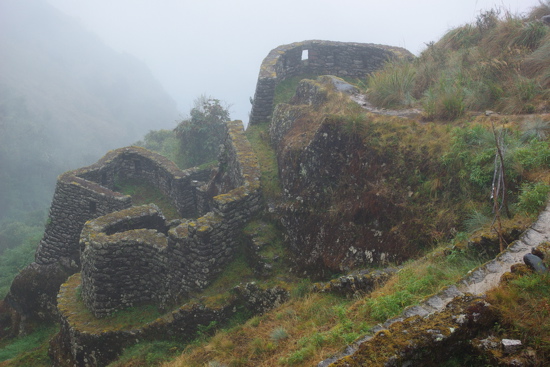
Soon, the nutty New Zealander caught up with us and we reached Phuyu Pata Marca, which in Quechuan means “Cloud-level Town.” How appropriate!

Phuyu Pata Marca

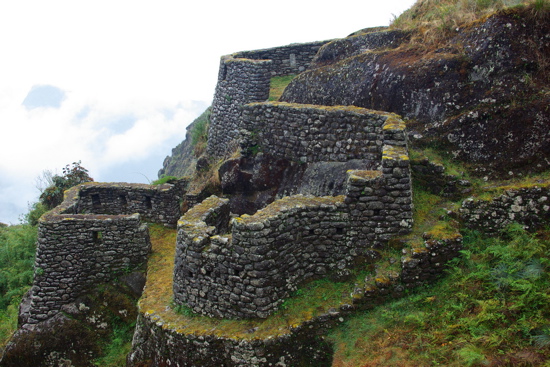
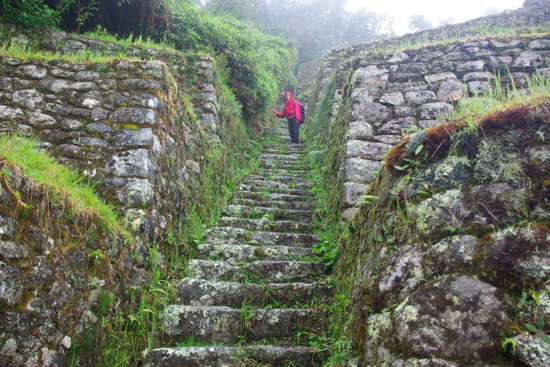
Very impressive stonework here. We spent 20 minutes going up and down the stairs, exploring the ruins.

Phuyu Pata Marca

Phuyu Pata Marca

As we neared the third campsite, the rain began yet again in earnest. There was a fork in the road, and we had a choice: either continue straight to the campsite, or take the long way around to see Intipata, another Inca site that was used primarily for agriculture. Well, sure, it was raining and we were wet, but how many times are we hiking the freaking Inca Trail?

Intipata

Intipata

Intipata

One (just one) advantage of the rain is that it makes colors more saturated for photographs. Also, I got to wear my pink raincoat, making me stand out like a brazen flower amid the ruins.

We arrived at the third campsite at Winay Wayna, where we would spend our last night before reaching Machu Picchu early next morning. There is a bar/restaurant in Winay Wayna, which we hit with the Quebecois. Beers were 10 soles each, an outrageous price until we reminded ourselves it was only $3.50 USD (still, for Peru, an outrageous price).

Dinner that night was sad — our last meal together! The porters baked us a cake. Somehow, they managed to steam eggy batter all afternoon until it formed a cake. It was delicious. In return, our group pooled together a bunch of money for the customary tips for the porters and cook. All 21 of the porters filed into the tent, and the only fluent Spanish speaker among us, the young lady from Connecticut, gave a touching speech about how grateful we were for their services. Everyone clapped. Then the Will the guide told us we’d be waking up at 3:45am the next morning. Mouths dropped open. He told us he wanted us to be the first group at the checkpoint gate into the area of Machu Picchu. The checkpoint opened at 5:30am, but he wanted to be there at 4:30am so we could be the first in, and also because the pavilion only had enough room for one group to stand in case of… (he didn’t say, but we were all thinking “in case of rain.”) I didn’t care about getting up at 3:45am, because I didn’t feel as if sleep would come to me that night, either. We left the dinner tent, peering up at the sky, looking in vain for stars to twinkle out from behind the fortress of clouds….

Posted in Trips.

Tagged with .


The Inca Trail: Day 2

Our first night on the Inca Trail, I slept horribly. Blame it on the noise from party in the village, blame it on the stiff mattress pad provided by the trekking company, blame it on the rain that began pattering on the tent about 3am, or blame it on the reputed “sacred energy vortex” upon which Machu Picchu and the Camino Inka are constructed, but I would get a total of 6 hours of sleep over the course of three nights of trekking. Despite/because of this, my body was perpetually revved.

So I was laying in my sleeping bag, listening to the rain grow in intensity, and then fade, and then grow again. Further away, I could hear the porters start to stir. Soon, Raoul the Assistant Guide came to wake us up, accompanied by two porters carrying a kettle of hot water and assortment of teas. This is the standard wake-up call for trekkers on the Inca Trail. I suppose the hot beverage is supposed to coax people awake, but I’m the type whose is prone to dawdling over her mate de coca.

I think I ate more carbohydrates at breakfast than I eat in a normal week. Everyone knew that the second day up Dead Woman’s Pass was the hardest, so toast, pancakes, and gruel were steadily consumed with grim faces. Our group was a motley assemblage of Anglophones (15 including us): One early-20s couple from Vancouver, one early-20s couple from England, one mid-20s couple from India who live in Minneapolis, one mid-40s couple from Montreal, two young British women who just graduated from university, a mother-daughter pair from Connecticut, and one lone rather nutty New Zealand lad who was traveling in South America for 5 months.

When we signed up for the Inca Trail, I had envisioned our trekking group being filled with gear-heads, but it turned out Mr. P and I were the only gear-obsessed hikers in the group, probably because we’re older and have bountiful disposable income. After breakfast, I put on my rain jacket and backpack rain cover. Several people didn’t have any rain gear whatsoever, and most people only had flimsy ponchos.

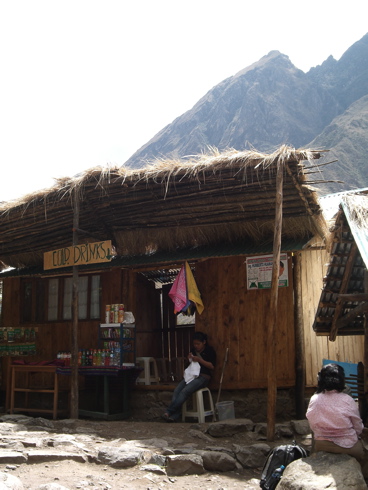
We bid goodbye to camp. Our next campsite would be more remote, without beer or water for sale.

Campsite Store

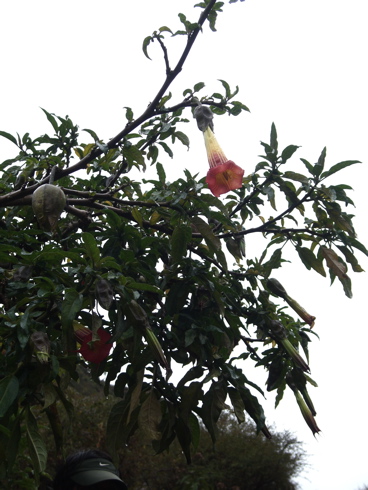
We paused to look at some exotic trumpet flowers. We would also see some hummingbirds, but they were too fast to photograph.

Inca Trail Flowers

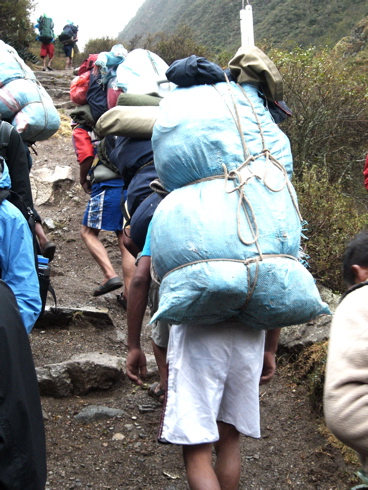
Porters from our group and other groups began to trot past us. They needed to get ahead to set up tents for our arrival. Notice that the porters wear sandals (heavily preferred over boots).

Porters

Our guide Will had initially wanted our group to stay together and take our time on this strenuous section of the trail, but the rain began to build in intensity, so he told us to go at our own pace to the mid-morning snack tent a few miles away.

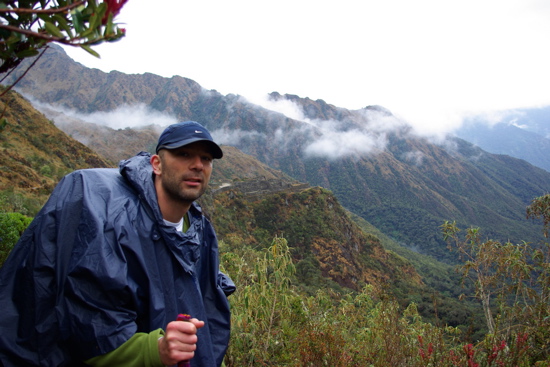
Mr. P on a Beautiful Trail in Shitty Weather

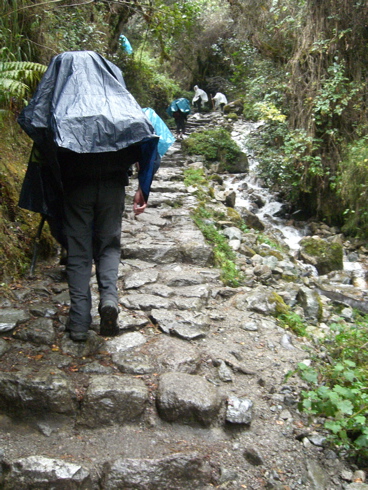
Really, really well-constructed trail. Somehow, despite our extra load and extra age, we were far ahead of most everyone in our group. Soon the two British girls caught up to us and the four of us would rush through the storm to the mid-morning snack tent.

Inca Trail

Because of our fast pace in the pouring rain, the porters weren’t ready for us at the mid-morning tent, so we stood under some trees as our group slowly converged. The unfortunate people without ponchos had completely soaked packs and sopped sleeping bags; our guides rushed around to find ponchos for them. After the mid-morning snack (tea, crackers, and a puffy cheese sandwich), it was time to face Dead Woman’s Pass. Originally we were going to have a group photo at the top, but due to the weather our guide instructed us to keep going until the campsite.

We started off. My survival instincts began to kick in. I just wanted to be done with this hike. All those hours in the White Mountains paid off as I doggedly hiked up the notoriously steep incline of Dead Woman’s Pass.

Porters Headed Up Dead Woman’s Pass

I was about 5 minutes from the top of Dead Woman’s Pass when the nutty New Zealander from our group passed me. He told the rain was getting ridiculous and he just wanted to finish. Indeed, the rain was beginning to freeze and the wind was voracious. I reached the top of Dead Women’s Pass, which was deserted except for a line of resting porters and the New Zealander, who now had bragging rights in our group, but whatever. He knows who was at his heels.

Porters on Top of Dead Woman’s Pass

The New Zealander and I stood together and peered down the pass, watching Mr. P trudge up the final steps. The New Zealander took our picture next to the sign with the “4125 meters” altitude. That’s 13829 feet! (Unfortunately, both Mr. P and I closed our eyes in the picture. We’ll just have to go back.)

On Dead Woman’s Pass

The weather wasn’t getting any better, so we headed down the pass. Our guide told us it would take 90 minutes, but it took us about 60 minutes. Close to the bottom, one of the British girls madly scampered by us. “I have to go to the loo!” she whispered to me. She was a super-fast hiker. She told me later that she was trying to stay with her friend, but the rain was getting too ridiculous.

We reached camp at 12:15. The rain was coming down strongly. A porter directed us to a tent and sorta pushed us into it. We were dripping wet, but our clothes and sleeping bags had stayed dry. I was shivering as I peeled off my wet clothes and dried off with a towel. All we could do was huddle in our tent.

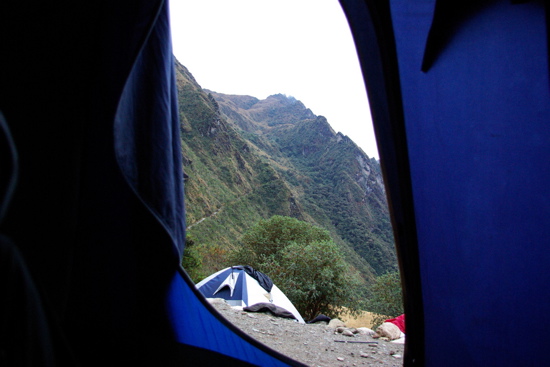
View from Tent

When the rain abated, I left the tent to use the restroom. The British girl invited me into her tent; she was lonely, so we chatted while she demolished a bag of chocolate raisins. Soon, other members of our trekking groups began trickling into camp. Lunch wasn’t until everyone arrived at 3pm; it turned out that conditions had really worsened on Dead Woman’s Pass, with hail and snow. One woman from another group was crying hysterically; another woman twisted her knee after skidding on some rocks; one man was taken down on horseback. I’m surprised no one developed hypothermia. The guide said that, in 12 years on the Inca Trail, he never saw snow on Dead Woman’s Pass at this time of year.

The rain stopped around 4:30pm and some sun even peaked out. The British girls started a game of charades. Optimism revived, then died as the clouds moved in and the rain commenced around dinner time. After dinner, the porters brought in a pitcher of a warm rum drink “to help you sleep,” but I would need a lot more than rum to help me sleep.

Day Two was a memorable on the Inca Trail, but for all the wrong reasons…

Posted in Trips.

Tagged with .


Moosilauke

Today’s weather being superlative, we could not resist sneaking up to the White Mountains for a day hike, even though we should have really stayed at home and taken CONTROL of our LIVES in the wake of the Peruvian vacation.

It was a science experiment, really, to see if any residual effects of hiking in high altitudes would bestow extraordinary cardiovascular abilities. And indeed, as we made our way up the infamously tough Beaver Brook Trail at Mount Moosilauke, we easily bounded past much younger, fitter-looking hikers who were confined by the amount of oxygen that their hemoglobin could process. They looked crestfallen as they stopped to catch their breath while these two oldies strode past them, talking and laughing with all their excess breath. I wanted to reassure them that, had we not just returned from hiking in Peru, we too would be madly aspiring.

The book time to the top of Mount Moosilauke via Beaver Brook: 3 hours and 25 minutes for 3.8 miles and 3100 feet of elevation gain. It took us 2 hours. Scary. “We are GODS,” I muttered to Mr. P as we veritably skipped to the summit.

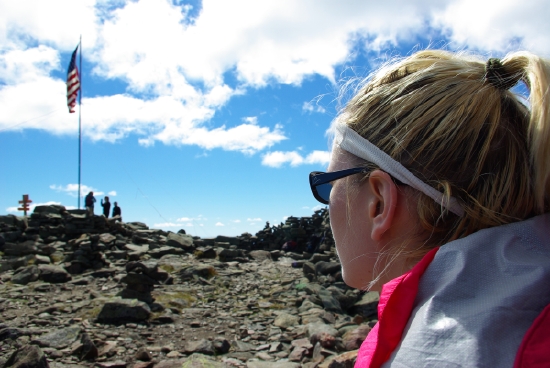
At the summit, some patriotic soul had strapped up an American flag, presumably to commemorate Sept 11. A nice touch, although if you ask me, the seemingly endless views of Moosilauke don’t need adornment.

“Men hang out their signs indicative of their respective trades: shoemakers hang out a gigantic shoe; jewelers, a monster watch; and the dentist hangs out a gold tooth; but up in the mountains of New Hampshire, God Almighty has hung out a sign to show.” — Daniel Webster

(With all due respect to the White Mountains and Daniel Webster, he obviously never saw the Andes.)

American Flag on Moosilauke Summit

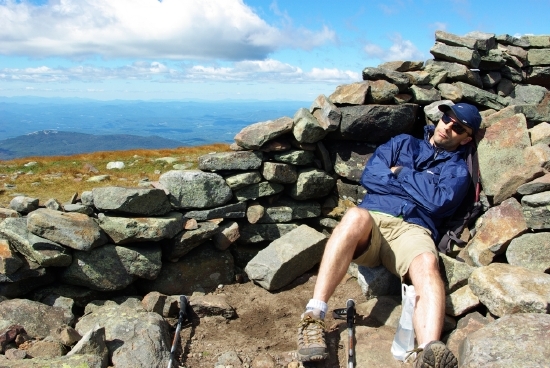
Anywhere I Lay My Head

Posted in 4000 Footers.

Tagged with .


The Inca Trail: Day 1

If you go to Machu Picchu — and it’s one of those places that everyone should theoretically aspire to go to — you can take a plane, then a train, and then a bus that will deliver you in relative comfort to the entrance of this most sacred Incan site. Or, if you want to experience Machu Picchu and you’re feeling slightly masochistic, you can hike in via the ancient Incan road system, the most popular of which is the Inca Trail, a 28-mile, 4-day journey through a lush landscape, Incan ruins, and oscillating altitudes.

Of course we would do the Inca Trail. It’s one of the most famous and historic trails in the world, so we would do it despite the requirement of paying hundreds of dollars to a trekking company, applying for a permit months in advance, and traveling with a group of 13 other people as well as a caravan of porters.

Our trekking company instructed us to be ready to be picked up at our hotel Monday morning between 5:20-6am. At 5:19am, I was just finishing packing (like most trekkers, we would be leaving some bags at our hotel) when a guy from the trekking company came to collect us. He hurried us through the streets of Cusco and deposited us on the bus, where of course we were the first ones. Over the next 40 minutes, the bus drove around Cusco, collecting the rest of our trekking group, and then finally our guides, William and Raoul, who instructed us to sit back and relax during the 90-minute drive to Ollantaytambo and KM82 of the Inca Trail, where we would begin.

When we got to Ollantaytambo, I noticed two things about the other 13 people in our group. One, most everyone (except for 2-3 others) was wayyy younger than us. Two, everyone was carrying very small book-bags, whereas Mr. P and I had these hulking backpacks. It turned out that most everyone (except for 2-3 others) had hired personal porters to carry the bulk of their stuff.

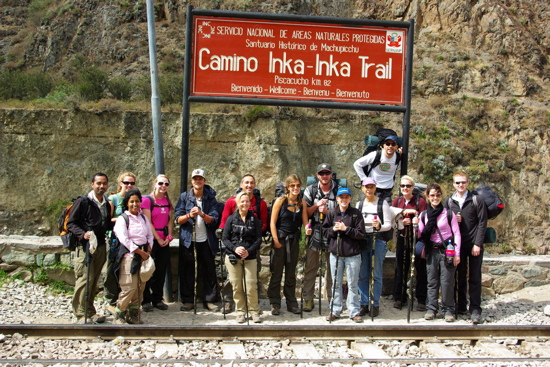
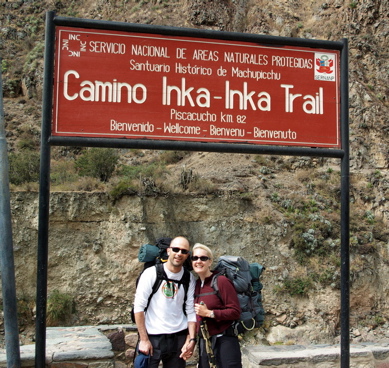
Here’s our group at KM82. How fresh we looked!

In the Beginning

The weather, incidentally, was gorgeous. Who could have possibly imagined that this was the last time we’d see the sun for the entire rest of the trek?

Aw!

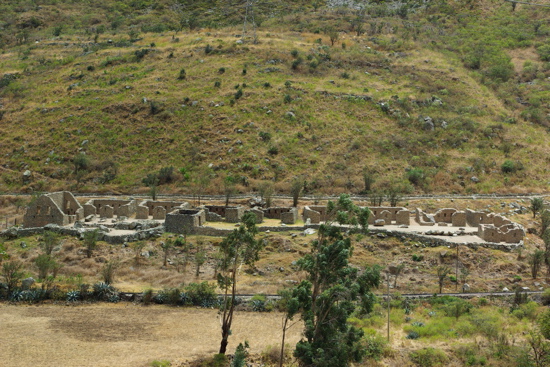
Our group started hiking. Right away there was an Inca site, although it was so insignificant I can’t recall its name or function.

Inca Site

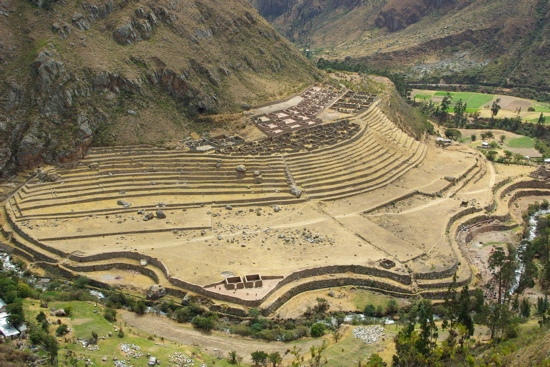
Much more interesting is Patallacta, an agricultural station with extensive terraced land. From the Inca Trail, we had a nice view of Patallacta, although we could not go to it:

Patallacta

Soon, we would have lunch. The 22 porters had traveled ahead of us so they could set up the meal tent and cook lunch for us when we arrived. The food was a pleasant surprise. The first course was sliced avocado topped with diced eggs and peppers — downright gourmet. Next we had fish accompanied by vegetables and plenty of rice and potatoes. As always, lunch ended with a hot beverage. Everyone was delighted.

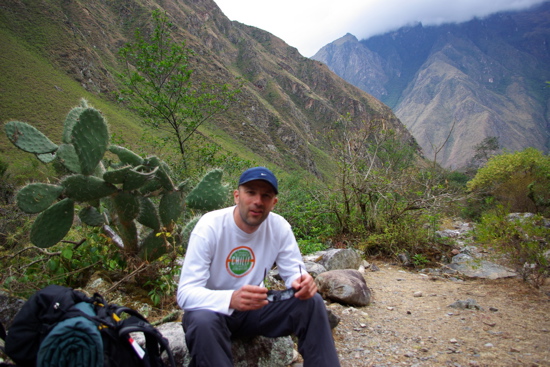
Mr. P on the Inca Trail

After lunch, our guide Will told us to hike at our own pace to our campsite so that he could judge our pace. This spurred several couples in our group to race to the campsite. Mr. P and I hung back, encumbered somewhat by our heavy backpacks, but also because we wanted to savor the Inca Trail. This was hiking heaven.

From the Inca Trail

Still, despite our nonchalance, I must brag that we were the third couple at the campsite.

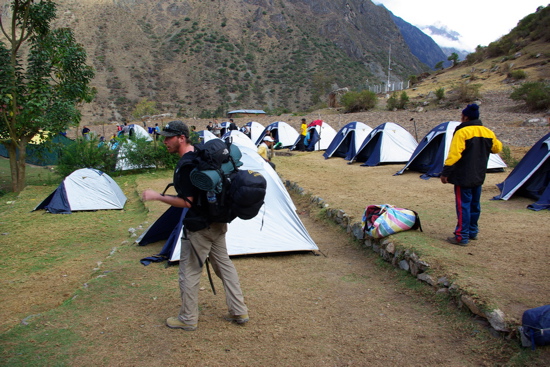
Campsite

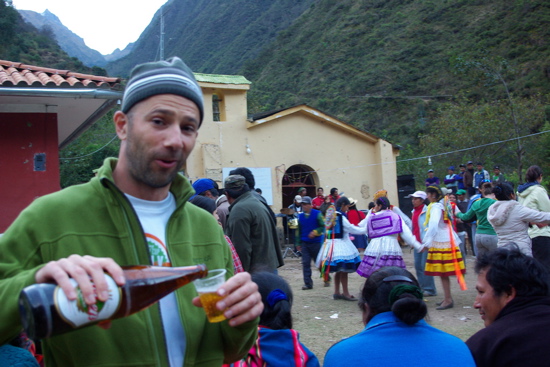
I must mention that since we arrived in Peru, the country was in the throes of a national holiday. Santa Rosa de Lima day commerated the death of St. Rose, a Pervuvian woman in the 18th century who cared for the sick. She also deliberately made herself ugly by chopping her hair off and rubbing coal on her face. All of which means… fiesta! The small village next to our campsite was having a party, and they didn’t seem to overtly mind if the trekkers came, and they were selling cheap beer, so:

Fiesta

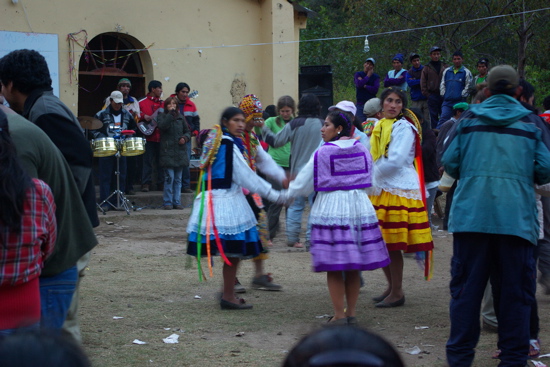
The locals were all drinking chicha, a corn beer that no Westerner dare touch due to its iffy manufacturing process, and also because chicha evidently can make you quite wasted. We witnessed a man so drunk that he tripped over a sleeping dog, and then turned around and kicked the dog (to the horror of the trekkers), and then struggled to his feet and tripped again, on nothing. Fiesta!

Fiesta

Soon, we went back to the campsite for dinner and then hit the hay, as it had been a long day, and Day Two would be the most physically punishing on the trek…

Posted in Trips.

Tagged with .


Sacred Valley

Our last day in Cusco, we took a day trip to the Sacred Valley, an area that boasts several major Inca sites and other various touristy areas. Perhaps ill-advisedly, on Friday we stopped in a tourist-baiting storefront near the Plaza de Armas and arranged the tour with a petite Peruvian woman who spoke good English. We paid 110 soles (about $40) for both of our bus tickets and lunches (this did not include the entrance fee for the three sites, which was another 140 soles — surprisingly pricey). The petite Peruvian advised us to come back Sunday morning at 8am in order to board the bus.

We arrived back at the storefront at Sunday morning at 8am only to find it closed. The petite Peruvian finally appeared at 8:15am and rushed us four blocks away to a city square flanked by various tour buses. “Wait here,” she ordered, and disappeared for 20 minutes. When she reappeared, she gestured frantically to a bus, which we boarded, and that was the last we saw of her. Another woman came by to take our names and hotel. The bus slowly filled up, and then a man ordered all of the Spanish speakers to get up and move to another bus, while roughly a half-dozen Anglophones were put on our bus. Finally, around 9am, the bus began to move.

But the bus was only half-full. We arrived at a hostel in a sketchier part of town and picked up an extended family of Peruvian Americans (the older generation was native Peruvian, but they all lived in New York and the four ‘tweenaged kids spoke no Spanish). The family filled out the seats around us. We idled for a bit as we waited for the bachelor Uncle Estaban to emerge from the hostel. Apparently, he was taking a shower. The bus returned to the square, where we picked up more people until the bus was full. By then, it was 9:30am, we had been on the bus for an hour, and we hadn’t gone anywhere.

Finally, finally the tour guide picked up the microphone and the bus left Cusco. We drove for about 45 minutes on winding mountain roads until we pulled over at a pseudo rest stop that consisted of two unflushable toilets and a large amount of souvenirs — not anything different than the touristy crap in Cusco, but the Peruvians Americans immediately began buying everything in sight: gloves, scarves, bags, carved frogs, and bird whistles. They boarded the bus, fully loaded with new toys to occupy their attention as the guide droned on about history and archaeology and stuff.

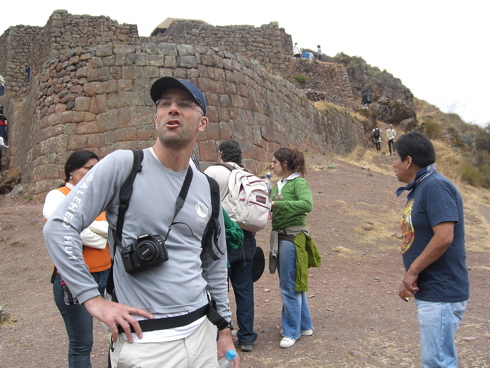
By the time we arrived at the Pisac Inca Ruins, I was dying to get off the bus. We bought our ticket and began hiking with the group up to the ruins. It wasn’t a very steep hike, yet most of the Peruvians-Americans began huffing and puffing. Honestly, it looked like many of them haven’t engaged in an activity more strenuous than opening a can of SpaghettiOs in many, many years. One Ecuadorian woman in her 60s strode past the 12-year old Peruvian-American boy named Eddie, a sonorous, rotund lad whose mother and grandmother fussed over him constantly (when they themselves weren’t breathing heavily from the effort of hauling their distended bodies up a few steps). At first I found amusement in their agony, but very soon it made me sad. This is what America does to people. It turns them into slothful lardasses.

Anyway: Pisaq. What a view.

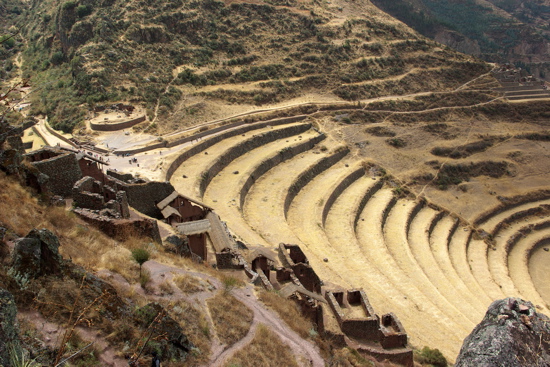
Agricultural Terraces at Pisac

The huge complex of ruins sat atop a great valley; across the rift, we could clearly see hundreds of catacombs. Unfortunately, we didn’t have time to fully tour the ruins, which contained numerous temples, citadels, and other important structures.

Pisac Terraces

After a brief explanation from our guide, we hurried back to the bus.

Mr. P at Pisac

On the way back to the bus, there were women selling souvenirs and also ears of corn. Most of us managed to resist buying an ear of corn, because lunch was less than 45 minutes away. But not Uncle Estaban, who boarded the bus 5 minutes late holding two ears of boiled corn. Meanwhile, his young niece was vomiting into a bag as her father held her hair back. They were sitting right in front of us, and the tour guide whisked them off the bus so she could be administered oxygen for altitude sickness. They came back 15 minutes later. Her extended family munched on corn as she continued to vomit into a bag.

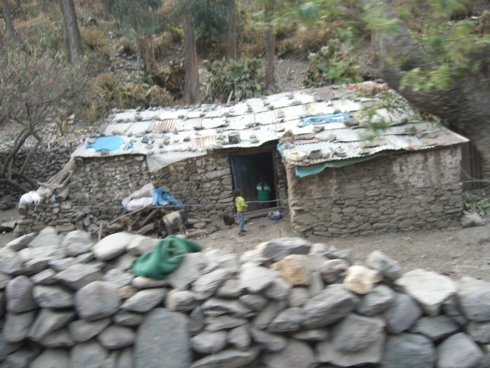
We drove on. I looked out the window, a little stunned by the poverty I saw: Houses without windows, children without shoes. Living in America, it’s too easy to forget how the other half lives.

Random House

We stopped for a buffet lunch in Urumba. It wasn’t half-bad, but it wasn’t half-good, either. Then, we continued onto Ollantaytambo, where another Incan site awaited.

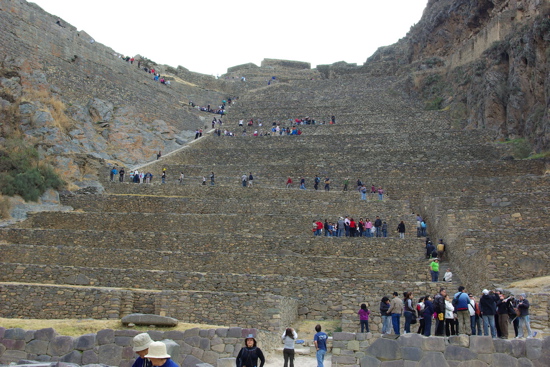
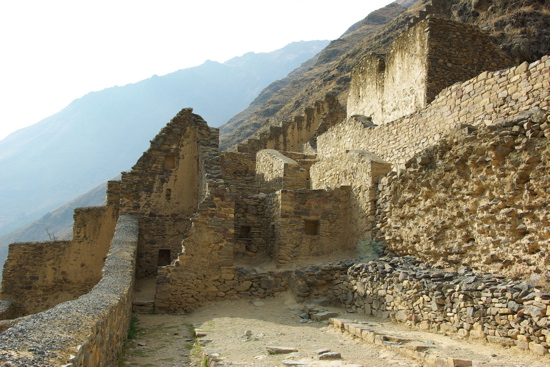
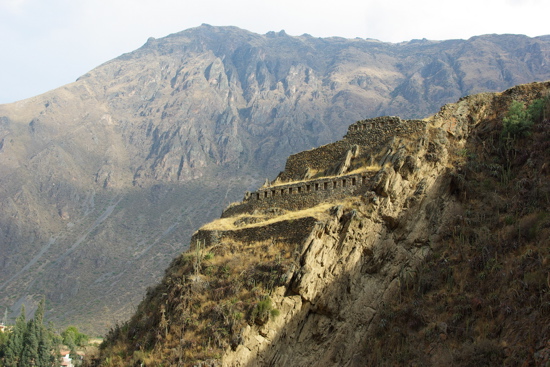
Ollantaytambo Incan Ruins

Lots of steps on this one! Most of the Peruvian-Americans stayed at the bottom, having been recently reminded of their dismal physical limitations. Young Eddie persevered onward.

Ollantaytambo

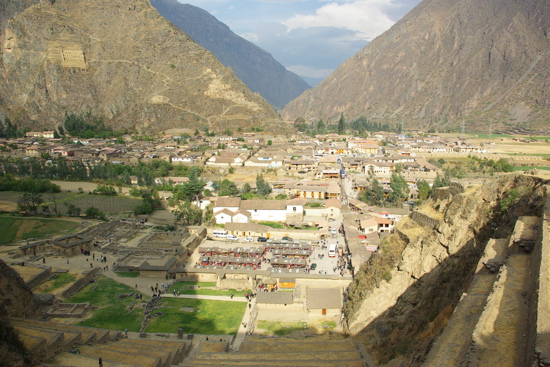
View of Ollantaytambo town from Ruins

Ollantaytambo

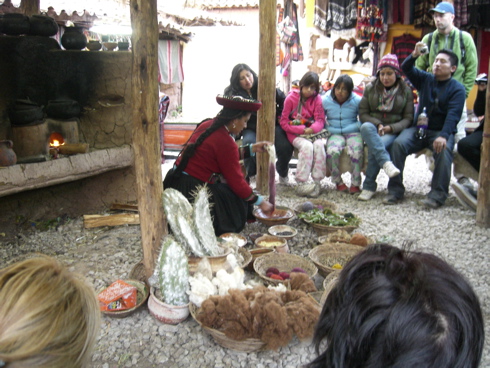
Too soon we were ushered back onto the bus to continue onto our final stop, Chinchero, which has no Inca ruins but a thriving market with high-quality crafts. When we arrived at Chinchero, we were given a demonstration of how they make those beautiful textiles that are available for purchase.

Chinchero Textile Lesson

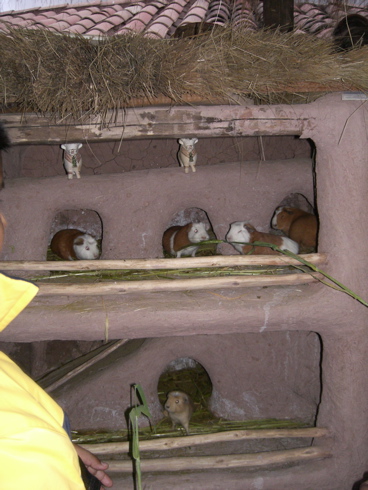
I was distracted by the community of guinea pigs located near the fire. Poor little delicious guinea pigs!

Guinea Pigs

Then we were unleashed on the vast Chinchero markets.

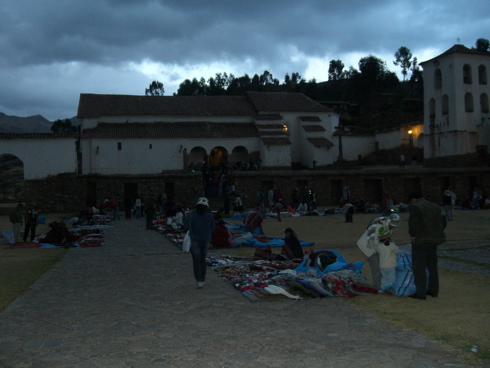
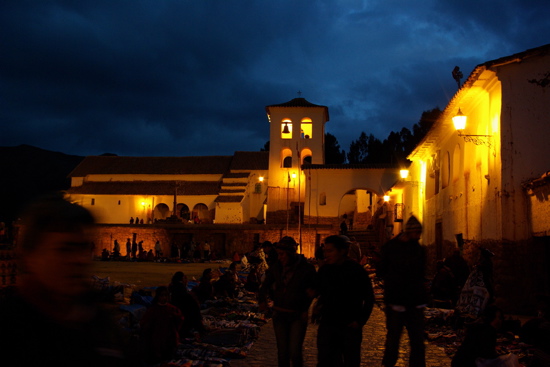
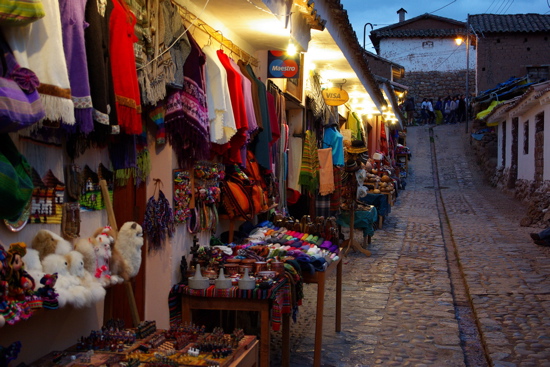
Chinchero markets

Chinchero markets and church

Chinchero Markets

We were due back on the bus at 6pm so we could arrive in Cusco at 7pm. The Peruvian-Americans lumbered onto the bus at 6:10pm with copious amounts of purchases. I wanted to leave without them, but once the bus started to move, I stopped caring. Tomorrow was Machu Picchu, and we had to wake up at 4:45am to be ready for the start of our trek. I tried to nap, but just when I started to drift off to sleep, the driver started to blast Hispanophone music, a grating duet of a low-pitched man and high-pitched woman set to upbeat rhythmic Latin music. So I stayed awake and looked out the window. I saw a man being mauled by a pack of stray dogs (a ubiquitous sight in Peru — stray dogs, that is). This witnessing would later be confirmed by a woman on the tour bus who would happen to be on my Inca Track. When we arrived in Cusco, we hurried to our hotel for dinner and our last night in actual beds before the Inca Trail commenced…

Posted in Trips.

Tagged with , .